The tunnel doesn’t look like much from the outside.
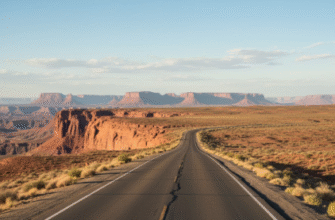
I mean, you’re driving through Zion National Park on the Mount Carmel Highway—Utah Route 9, if you want to be technical about it—and suddenly there’s this gaping hole in the cliff face, roughly 1.1 miles long, carved through Navajo sandstone that’s been sitting there for something like 180 million years, give or take a few epochs. The Zion-Mount Carmel Tunnel opened in 1930, back when the idea of blasting through a mountain seemed less like ecological sacrilege and more like the kind of ambitious infrastructure project that made engineers weep with joy. It took three years to build, cost about half a million dollars (which was, honestly, a staggering amount of money during the Depression), and required workers to dangle from ropes while they drilled and dynamited their way through rock that had withstood everything the Jurassic period could throw at it. The tunnel has these strange gallery windows cut into the side—five of them, I think, though I’ve lost count—where you can glimpse the canyon below if you’re not too busy white-knuckling the steering wheel because, here’s the thing, the tunnel is narrow. Like, really narrow for modern RVs and trucks.
Anyway, once you emerge on the eastern side, the landscape does something weird. The red cliffs are still there, obviously, but now they’re arranged differently, stacked and fractured in ways that make you reconsider what you thought you knew about geology.
Checkerboard Mesa sits just a few miles past the tunnel’s eastern portal, and it’s one of those formations that looks almost artificially designed—like someone took a massive block of cream-colored sandstone and scored it with a grid pattern, horizontal lines intersecting vertical cracks in a way that seems too regular to be natural. But it is natural, turns out. The horizontal lines are ancient cross-bedding patterns from when this whole region was a massive sand dune field during the Jurassic, back when Utah’s climate resembled modern-day Sahara more than it resembled, well, Utah. Wind blew sand into dunes, the dunes lithified over millions of years, and the layers preserved the angle of those ancient slopes. The vertical fractures came later—joints that formed as the rock expanded when overlying sediment eroded away, releasing pressure. I used to think erosion was just about things wearing down, getting smaller, disappearing. But here erosion creates patterns, reveals geometry that was hidden inside the stone all along.
Wait—maybe I should mention the Red Cliffs properly.
The Red Cliffs aren’t a single feature, exactly, but more of a color scheme that dominates the western approach to the tunnel, where iron oxide stains the Navajo sandstone in shades that range from pale salmon to deep rust, depending on how the light hits and how recently it rained. These cliffs tower above the switchbacks—the highway gains about 2,500 feet in elevation over a relatively short distance, and the engineers who designed this route in the 1920s must have been either brilliant or slightly unhinged, possibly both. The road curves back on itself in tight hairpin turns, each one offering a new angle on the canyon walls, which are riddled with alcoves and hanging gardens where water seeps through the porous sandstone and creates unexpected pockets of green. Columbines, maidenhair ferns, monkey flowers—plants that definately shouldn’t survive in what’s essentially a high-desert environment, but they do, clinging to moisture that gravity pulls downward through 200-million-year-old stone. There’s something almost stubborn about it, the way life finds these impossible niches and just… persists.
When Stone Tells Time in Layers You Can Actually Touch
The cross-bedding in Checkerboard Mesa isn’t just decorative.
It’s a record of wind direction from the Jurassic period, preserved with such fidelity that geologists can reconstruct prevailing wind patterns from 180 million years ago by measuring the angle of those petrified dune slopes. Each layer represents a different dune, a different moment in deep time when sand grains tumbled down the slip face and came to rest at an angle of about 30 to 34 degrees—the natural angle of repose for dry sand, a number that apparently hasn’t changed since the dinosaurs were around. I guess it makes sense that physics would be consistent across geological eras, but there’s something quietly astonishing about seeing it written in stone like that, layer after layer of frozen motion. The Navajo sandstone formation is massive here—up to 2,200 feet thick in some places—and it extends across southern Utah, northern Arizona, northwestern New Mexico, and southern Nevada, making it one of the largest ancient sand dune deposits on Earth. The scale is hard to wrap your head around: a sand sea bigger than the modern Sahara, buried and compressed and uplifted and carved by water into the shapes we see today.
What Happens When You Engineer Through Geological Immortality
The tunnel changed everything, obviously. Before 1930, getting from Zion Canyon to the eastern plateaus meant a multi-day journey around the park. After the tunnel, it took an hour, maybe less. But the construction process was brutal—workers faced constant danger from rockfalls, explosive misfires, and the sheer physical toll of drilling through sandstone in summer heat that regularly exceeded 100 degrees Fahrenheit. One worker died during construction, though the historical records are frustratingly vague about the details. The Park Service still restricts traffic through the tunnel: vehicles wider than 7 feet 10 inches or taller than 11 feet 4 inches require an escort and have to drive down the center, which means they close one direction of traffic entirely, causing backups that can stretch for miles during peak season. I’ve sat in those backups, engine idling, watching the heat shimmer off the pavement while tourists get out of their cars to take photos of the cliffs, which look almost fake in the afternoon light, too red, too vertical, too textured to be real.
Honestly, the whole drive feels like moving through different chapters of Earth’s autobiography, each turn revealing another paragraph written in stone.