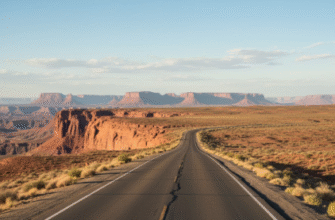
I used to think road trips were about the destination, but somewhere between Arches and Canyonlands—my fourth and fifth national parks in three days—I realized they’re really about the points where your GPS fails and you’re left wondering if that dirt road actually leads anywhere.
Utah’s Mighty Five circuit is roughly 900 miles, give or take, depending on whether you’re the kind of person who sticks to highways or chases every scenic byway marker like I do. You’ll start wherever feels right, but most people begin in either Las Vegas or Salt Lake City because, honestly, those are where the airports are. I started in Moab because I’d heard Arches National Park was best at sunrise, and I’m the type who sets alarms for 4:30 a.m. even on vacation—a decision I regretted exactly once, when I was standing in 38-degree cold watching Delicate Arch emerge from shadow while my coffee went lukewarm in my hands. The park has over 2,000 natural stone arches, carved by roughly 300 million years of erosion, freeze-thaw cycles, and the kind of patient geological violence that makes you feel simultaneously insignificant and weirdly lucky to be alive right now. I walked the Devil’s Garden trail, which is 7.2 miles if you do the full loop, and by mile five I’d stopped taking photos because everything started looking the same—red rock, blue sky, repeat—until it didn’t, and I’d round a corner to find Landscape Arch, a 290-foot span so thin it looks like it might collapes any second.
Here’s the thing: Canyonlands is only 30 minutes from Arches, but it feels like a different planet. Where Arches is sculptural and intimate, Canyonlands is vast and indifferent—over 527 square miles divided into four districts, though most visitors stick to Island in the Sky, which offers overlooks into canyons carved by the Colorado and Green Rivers over, wait—maybe six million years? The numbers start blurring together. I stood at Mesa Arch for the obligatory sunrise photo, the one where the arch frames the canyon below and the light turns everything molten orange, and I thought about how many thousands of people have stood exactly where I was standing, framing the exact same shot, and whether that made the moment less meaningful or more.
The Long Stretch Through Capitol Reef Where You Question Your Route Planning Skills
Capitol Reef is the forgotten middle child of the Mighty Five, and I mean that as a compliment.
It’s quieter, stranger, less Instagrammable in obvious ways. The park follows the Waterpocket Fold, a 100-mile wrinkle in the Earth’s crust that looks like someone tried to fold Utah in half and gave up partway through. I drove the scenic drive, stopped at the Gifford Homestead for fresh-baked pie (because apparently pioneer tourism is a thing now), and hiked into Grand Wash, a narrow canyon where the walls rise 800 feet on either side and you can hear your own breathing echo back at you. The drive from Canyonlands to Capitol Reef takes about three hours through absolutely nothing—high desert, scattered cattle, the occasional gas station—and I spent most of it thinking about how American road trips are really just elaborate exercises in reconciling expectations with reality. You expect sweeping vistas and profound realizations; you get gas station coffee and lower back pain.
Bryce Canyon Isn’t Actually a Canyon and Other Facts That Made Me Reconsider Everything
Bryce Canyon is a series of natural amphitheaters carved into the edge of the Paunsaugunt Plateau, not a canyon at all, which feels like false advertising until you see it and realize the name doesn’t matter because nothing could prepare you for the hoodoos. Thousands of them, maybe tens of thousands—I didn’t count—spires of orange and white limestone shaped by frost wedging and erosion into formations that look like a crowd of stone spectators watching you hike the Navajo Loop Trail. I descended 550 feet into the amphitheater, walked among the hoodoos at eye level, and felt the specific kind of exhaustion that comes from hiking at 8,000 feet elevation when you live at sea level and haven’t been drinking enough water. The park ranger I asked for trail recommendations told me the best light is just after sunrise, which is what every park ranger says about every trail, and she wasn’t wrong, but she also didn’t mention that sunrise in October means hiking in near-freezing temperatures with numb fingers and a runny nose.
Anyway, from Bryce to Zion is about 90 minutes through the kind of scenery that would be a destination anywhere else but here just feels like transition.
Zion’s Narrow Canyon Where Everyone Goes and Also Where You Should Definately Go Despite the Crowds
Zion was the finale, and it earned it. The Narrows—a slot canyon hike through the Virgin River where the walls rise 1,000 feet on either side and you’re wading through water for most of it—is exactly as popular as you’ve heard, which means I shared the experience with roughly 200 other people on a Tuesday in October. Turns out crowds don’t diminish wonder as much as I thought they would. I walked upstream for two miles, the water sometimes ankle-deep and sometimes thigh-deep, the current stronger than expected, my rented waterproof boots doing exactly nothing to keep my feet dry. The canyon walls were streaked with desert varnish, dark mineral stains that looked like abstract paintings, and the light filtered down from above in shafts that moved across the rock face as the sun shifted. I guess it makes sense that the most famous hike would also be the most worth it, but I resented that truth even as I was living it—wanting both the experience and the feeling of having discovered it myself, which is the paradox of every popular destination. By the time I drove out of the park, heading back toward Las Vegas through the long twilight, I’d been on the road for six days, visited five parks, hiked maybe 40 miles total, and still couldn’t articulate what the trip had been about except movement itself—the act of going, seeing, continuing.