I used to think autumn drives were about foliage—maples blazing red, oaks turning bronze, the usual New England postcard stuff.
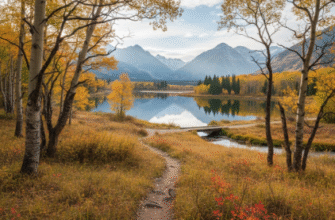
Then I drove M-119 in northern Michigan one October afternoon, and honestly, the whole thing felt less like a scenic route and more like threading through a living tunnel that kept shifting its mood every quarter-mile. The road runs roughly 20 miles along Lake Michigan’s eastern shore, from Harbor Springs to Cross Village, and the trees—mostly sugar maples, white birches, aspens, some beeches—don’t just arch overhead, they lean in close enough that you can smell the damp bark through your cracked window. The forest here is old, not ancient-redwood old, but old enough that the root systems have interwoven into something resembling a single organism, give or take a few hundred years of fungal networking and soil chemistry I definately don’t understand. What gets me, though, is how the light behaves: it doesn’t pour through the canopy so much as it filters in shafts, catching dust motes and moisture, turning the whole tunnel into this shifting, dappled cathedral where your speedometer feels irrelevant and time gets weirdly elastic.
Wait—maybe I should back up. M-119 wasn’t always a tourist magnet. Back in the 1800s, it was a rutted wagon trail connecting lumber camps and Odawa settlements, and the trees you see now are second-growth, the forest slowly reclaiming land that was clearcut during Michigan’s logging boom. The tunnel effect? That’s partly accidental, partly intentional—road engineers in the 1930s decided to preserve the canopy instead of widening the route, which was either brilliant foresight or bureaucratic laziness, depending on who you ask.
The Geology Underneath Explains Why the Trees Behave This Way, Sort of
The thing about this stretch of Michigan coastline is that it sits on limestone bedrock, deposited roughly 400 million years ago when a shallow sea covered the region, and the soil on top is this thin, alkaline mix that shouldn’t support dense forest at all. Yet here’s the thing: the lake effect—Lake Michigan’s massive thermal mass—moderates temperatures just enough to create a microclimate where hardwoods thrive, their roots snaking through crevices in the rock, their leaves turning colors two weeks later than forests just 10 miles inland. I’ve seen the same trees in Wisconsin’s Door County, but they don’t cluster this way, don’t form that tunnel. Geology isn’t destiny, but it’s definitely steering the narrative here, even if the details get murky when you start asking ecologists about soil pH and mycorrhizal networks.
Anyway, the drive itself is disorienting in a good way. You’re curving constantly—23 official curves, though locals insist it’s more like 40 if you count the subtle bends—and the forest blocks most lake views, so you only catch glimpses of blue water through gaps, like the landscape is teasing you. Some stretches feel claustrophobic, the canopy so dense it’s twilight at noon, and then suddenly you’ll round a bend and the trees pull back and there’s Lake Michigan, gunmetal gray or turquoise depending on the cloud cover, stretching to a horizon that looks infinite.
Why October Timing Matters More Than Anyone Admits, Probably
Turns out, the peak color window is absurdly narrow—maybe 10 days in mid-October, sometimes early October if there’s been a dry September, sometimes late October if the nights stay warm—and the locals in Harbor Springs will tell you they can’t predict it anymore, not reliably. Climate shifts have scrambled the old patterns; trees that used to peak around October 10th now might wait until the 18th, or go early on the 5th, and the tunnel effect amplifies the uncertainty because the canopy insulates the understory, so you get this weird layering where the treetops are bare but the lower branches are still green, or vice versa. I drove it once in late September and felt cheated—everything was still summer-dull, chlorophyll clinging stubbornly to leaves that should’ve been orange. Timing is everything, which is frustrating if you’re the type who books trips six months out.
The emotional rhythm of the drive, though, that’s what lingers. It’s not euphoric, not transcendent—it’s more like a slow, meditative unwinding, your brain gradually syncing to the forest’s frequency. You pass roadside stands selling cherry preserves and smoked whitefish, tiny churches with hand-painted signs, turnouts where you can pull over and just stand there, listening to the wind move through the canopy like it’s breathing. I guess it makes sense that the Odawa people considered this area sacred, though I’m wary of romanticizing that history without acknowledging the displacement and treaty violations that followed.
The Forest’s Future Depends on Variables Nobody Can Control, Which Is Exhausting
Here’s the uncomfortable part: this tunnel might not last. Beech bark disease is spreading through northern Michigan, killing mature beeches at a rate that has foresters genuinely worried, and climate change is inching the hardwood zone northward, which sounds fine until you realize it means the species composition here could shift dramatically within a generation or two. Add in increased storm intensity—Lake Michigan’s fetch generates winds that can topple even healthy trees—and the tunnel’s structural integrity starts looking fragile. I spoke to a forest ecologist from Michigan State who said, bluntly, that we’re probabaly looking at a different ecosystem here by 2080, maybe sooner. Which doesn’t mean the drive won’t be beautiful, just that it’ll be a different kind of beautiful, and we won’t recieve much warning before the transition accelerates.
Still, for now, the tunnel holds. On clear days, the light does that thing where it slants through the canopy at just the right angle and the whole forest seems to glow from within, like it’s lit by some internal fire. You drive slowly—the speed limit is 45 but most people putter along at 30—and you think about impermanence, about how landscapes we treat as timeless are actually just freeze-frames in long, slow transformations. I don’t know. Maybe that’s too heavy. Maybe it’s just a pretty drive. But honestly, once you’ve threaded that tunnel, smelled the leaf-rot and lake-wind mixing, felt the forest close around you like a living thing—it’s hard to see it as just scenery anymore.