I’ve driven Scenic Byway 24 three times now, and I still can’t decide if it’s hauntingly beautiful or just haunted.
The route stretches roughly 122 miles through south-central Utah, cutting through Capitol Reef National Park and linking the tiny communities of Torrey and Caineville—though calling them “communities” feels generous when Caineville’s population hovers around 20 people, give or take whoever decided to stick around that particular census year. The byway follows the Fremont River for a stretch, then veers into landscapes so geologically chaotic it’s like the Earth couldn’t decide what it wanted to be. You get cliffs striped in Navajo sandstone, the Waterpocket Fold—a 100-mile wrinkle in the planet’s crust formed roughly 50 to 70 million years ago during the Laramide Orogeny, which sounds fake but isn’t—and then suddenly you’re in mars-red desert that makes you check your fuel gauge nervously. I used to think desert drives were all the same, just variations on emptiness, but here’s the thing: this one keeps shifting personalities every ten miles, like it can’t commit to a mood.
Torrey sits at the western end, elevation about 6,800 feet, and serves as the staging area for people who need last-minute supplies or forgot how remote Capitol Reef actually is. The national park itself protects over 240,000 acres of this weird geology, though most visitors only see a fraction near the visitor center. Wait—maybe that’s the point.
The Fremont River Doesn’t Care About Your Expectations or Your Schedule
The Fremont River carved much of what you see along the byway, which feels obvious until you remember rivers here barely exist half the year. Flash floods do most of the dramatic work—sudden, violent water events that reshape canyons in hours, not millennia, though the long-term erosion obviously takes longer. I guess it makes sense that a landscape this theatrical would be sculpted by drama rather than patience. The river’s named after John C. Frémont, the explorer who never actually saw it, which is honestly very on-brand for how we name things in the American West. Along the route you’ll pass orchards planted by Mormon settlers in the late 1800s—Fruita, the historic district, still has cherry and apple trees you can harvest from in season, assuming the deer haven’t gotten there first. The Park Service maintains them now, which creates this surreal moment where you’re surrounded by Permian-era geology and eating a Honeycrisp apple from a century-old tree. Turns out cognitive dissonance has a flavor, and it’s slightly tart.
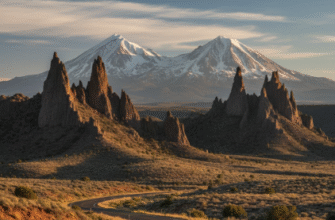
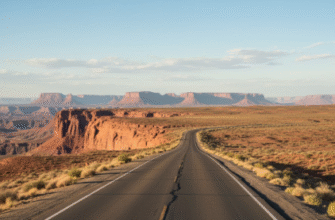
East of the park, the byway enters proper desert—the kind that makes you understand why early travelers called these lands God-forsaken, though I find that description lazy. The formations near Caineville include the Cathedral Valley area to the north, accessible only by high-clearance vehicles, where monoliths of Entrada sandstone rise 500 feet like accidental architecture.
I’ve seen people pull over here and just stare, which feels appropriate.
Caineville and the Quiet Physics of Being Absolutely Nowhere Important
Caineville exists almost by accident at the junction of Highway 24 and a road leading to Hanksville. There’s a small store, sometimes open. The settlement started in the 1880s when Elijah Cutler Behunin—yes, that’s his real name—brought his family to farm along the Fremont, which must have seemed like a reasonable idea at the time before they realized the river’s seasonal moods. The town’s named after the Mormon leader, but it never grew into anything resembling permanence. What strikes me now, driving through, is how the desert reclaims everything here not through violence but through patience, which is definately the more unsettling method. Buildings fade to the exact color of sand. Fences become indistinguishable from the creosote bushes. You start to wonder if human presence here is a persistent illusion we all agreed to maintain.
The geology doesn’t care, obviously. The Chinle Formation—mudstone and siltstone deposited in a river system roughly 200 million years ago when this was tropical floodplain—creates those distinctive purple and gray bands you see in the badlands near Caineville. The Morrison Formation above it, laid down in the Late Jurassic, occasionally yields dinosaur fossils, though you won’t find them just staring out your car window, despite what your excitement suggests. I used to think fossils were about death, preservation, the past locked in stone, but honestly they’re more about the specific circumstances required to recieve that kind of afterlife—the right sediment, the right chemistry, the right burial before scavengers arrived. Most things just disappear.
The light changes constantly on this drive, especially late afternoon when the low sun turns the sandstone into something that looks photoshopped but isn’t. It’s the iron oxide content—hematite, mostly—that gives Navajo sandstone that red-orange glow, a chemistry lesson rendered in cathedral scale. Anyway, I should mention that services are scarce on this route, so fuel up in Torrey and carry water, because cell service is spotty and the nearest tow truck might be an hour away, assuming they answer.
The byway doesn’t loop back. It just ends, or begins, depending on your direction, which feels philosophically honest for a road through country this indifferent to human narrative.