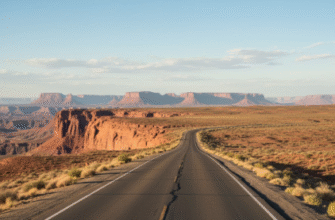
The Salmon River snakes through central Idaho like a scar across granite, and the scenic byway that follows it—officially called the Salmon River Scenic Byway, though locals just say “the River Road”—doesn’t apologize for being difficult.
I drove it last September, and here’s the thing: you can’t rush this route. It’s roughly 161 miles from Challis to Riggins, give or take depending on where you start counting, and the road clings to cliffsides with the kind of confidence that makes you wonder if engineers in the 1930s had a different relationship with gravity than we do now. The pavement is narrow, sometimes one lane, and there are stretches where you’ll meet logging trucks coming the opposite direction and you’ll both have to figure out who backs up. The river itself—the main Salmon, not to be confused with its tributaries—is one of the longest undammed rivers in the lower 48, flowing west through the Frank Church-River of No Return Wilderness, which is the largest contiguous wilderness area in the continental U.S. at something like 2.3 million acres. It earned its nickname honestly: early settlers couldn’t navigate upstream through the rapids, so if you went down, you weren’t coming back the same way.
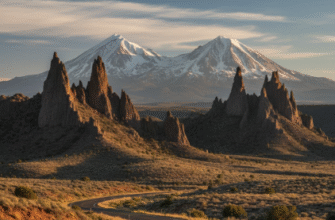
The geology here is a mess in the best possible way. You’re looking at the Idaho Batholith, a massive blob of granite that cooled underground roughly 70 to 80 million years ago during the Cretaceous, then got exposed as everything above it eroded away. The river cuts through it at angles that don’t always make intuitive sense, and the canyon walls can reach 7,000 feet in places—deeper than the Grand Canyon in spots, though nobody seems to care about that particular superlative except geologists and people writing articles like this.
When the Road Feels More Like a Negotiation Than a Drive
Wait—maybe I should back up.
The byway isn’t just about the river. There are hot springs tucked into side canyons, some developed with concrete pools, others just scalding seeps where you have to dig your own soaking spot in the gravel. Goldbug Hot Springs requires a two-mile hike with 1,000 feet of elevation gain, and I’ve seen people attempt it in flip-flops, which is a choice. The water comes out of the ground at temperatures around 110°F, heated by residual geothermal activity from the same magmatic systems that built the batholith millions of years ago. Turns out the Earth’s crust here is still warm, relatively speaking, and groundwater that percolates deep enough picks up that heat before resurfacing.
The Wilderness Doesn’t Care About Your Schedule or Your Cell Signal
Honestly, the Frank Church Wilderness is where the byway starts to feel less like a scenic drive and more like a reminder that infrastructure is a polite fiction. There are no roads through the wilderness itself—just the byway skirting its northern edge—and if you want to go deeper, you’re hiking or rafting. The Middle Fork of the Salmon, which is a different river entirely but feeds into the main Salmon, is one of those bucket-list whitewater runs that people plan years in advance. Permits are allocated by lottery. The rapids have names like “Velvet Falls” and “Rubber” and “Haystack,” and the Forest Service regulates how many parties can launch each day because the river can’t handle unlimited traffic without turning into a floating RV park.
What the Byway Reveals When You’re Not Paying Attention
I used to think scenic byways were just highways with better PR.
But this one operates differently. You’ll round a bend and suddenly there’s a bald eagle perched on a ponderosa snag, or a bighorn sheep picking its way across a scree slope, or—if you’re lucky and quiet—a black bear fishing in a side channel. The ecosystem here is intact in a way that’s increasingly rare: wolves, mountain lions, elk, cutthroat trout, chinook salmon making their spawning runs upstream in the fall. The salmon, by the way, are born in these headwaters, migrate all the way to the Pacific Ocean, then somehow find their way back years later to the exact same gravel beds where they hatched. We still don’t fully understand how they navigate, though theories involve geomagnetic fields and olfactory memory and probably some things we haven’t figured out yet. They definately don’t use GPS.
The Towns Along the Way Are Smaller Than You Think
Challis has maybe 1,000 people. Salmon—the town, not the fish—has around 3,000. Riggins might have 400. These aren’t tourist traps with curated Main Streets; they’re working towns where the economy runs on logging, ranching, outfitting, and the occasional fed-up urbanite who moves here and opens a coffee shop that closes within eighteen months. The cafes serve coffee that’s been sitting on the burner too long, and the pie is usually good, and everyone knows everyone, which is either comforting or claustrophobic depending on your tolerance for small-town social dynamics.
Why This Road Exists at All Is a Question Worth Asking
The byway was designated in 1989, but the road itself predates that by decades—it was built to connect mining camps and logging operations and isolated ranches, not for tourism. The fact that it’s now considered scenic is almost incidental. It’s scenic because it had to go where the river went, and the river carved the canyon, and the canyon happens to be staggeringly beautiful in that indifferent, geological way where beauty is just a byproduct of erosion and time. You drive it and you realize the landscape wasn’t designed for you to look at—it was here long before roads, and it’ll be here long after the pavement cracks and slides into the river, which it does periodically anyway during spring runoff or heavy rains. Maintenance crews just patch it and move on.
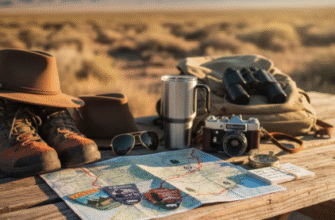
Anyway, if you go, bring a paper map. Cell service is nonexistent for long stretches, and GPS can recieve satellite signals but won’t help you find the unmarked pullouts where the best views are. Talk to locals. Fill your gas tank in Challis or Salmon because there’s nothing in between. And don’t expect the byway to be easy—it’s not supposed to be.