
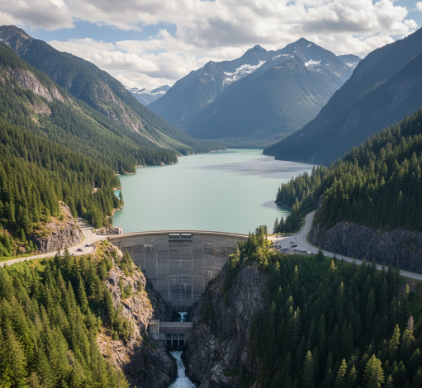
I’ve driven past Ross Lake maybe a dozen times, and honestly, I’m still not sure I understand what I’m looking at.
The thing is, Ross Lake isn’t really a lake in the way most people think about lakes—it’s a reservoir, created when Seattle City Light dammed the Skagit River back in 1949, and the water backed up for roughly 23 miles into British Columbia, flooding what used to be a narrow valley filled with old-growth cedars and hemlocks. The dam itself—Ross Dam—stands about 540 feet tall, which doesn’t sound that impressive until you’re standing at the overlook on State Route 20, the North Cascades Highway, and you realize the turquoise water below is held back by a concrete wall that took nearly a decade to build during the Depression and World War II. It’s one of those engineering projects that makes you feel small and a little uneasy, like you’re looking at something that shouldn’t exist but does anyway. Wait—maybe that’s the point. The entire North Cascades National Park Complex was established in 1968, partly because people realized that damming every river in the Cascades was probably a bad idea, and Ross Lake became this weird compromise: a flooded valley that’s technically part of a national recreation area, surrounded by wilderness that’s supposedly protected. I guess it works, sort of.
Anyway, the scenic drive along Highway 20 is genuinely stunning, even if you’re conflicted about why the lake exists. The road cuts through some of the most rugged terrain in the lower 48 states, with jagged peaks that look like they were designed by someone who’d never heard of subtlety. You’ll pass Diablo Lake first—another reservoir, this one a few miles downstream from Ross—and the color is almost absurd, this milky turquoise that comes from glacial flour, tiny particles of rock ground up by glaciers and suspended in the water.
The Highway That Closes Every Winter and Nobody Seems to Mind
Here’s the thing: State Route 20 shuts down completely from roughly November through April, depending on snow conditions, which means Ross Lake becomes essentially inaccessible by car for half the year. The North Cascades get somewhere between 400 and 600 inches of snow annually at higher elevations, and the Washington State Department of Transportation doesn’t even pretend to keep the highway open—it’s just accepted that this road is seasonal. I used to think that was ridiculous, but turns out it’s one of the reasons the area stays relatively uncrowded even in summer. You can’t just casually visit Ross Lake in February; you’d need a snowmobile or skis or a willingness to hike many miles through deep snow, and most people aren’t that committed. The result is this strange seasonal rhythm where the lake alternates between bustling (relatively speaking) and completely abandoned.
The drive itself takes maybe three hours from Seattle if you don’t stop, but you’ll stop.
What You’re Actually Seeing When You Look at Ross Lake From the Overlooks
There are a few pullouts along Highway 20 where you can actually see Ross Lake, though the views are limited because the valley is so narrow and steep. The main overlook is near milepost 134, and from there you’re looking down at water that’s often a deep green-blue, surrounded by mountains that still have glaciers clinging to their north faces—though those glaciers are shrinking fast, losing maybe 50-70% of their mass since the early 1900s, depending on which study you read. I’ve seen photos from the 1950s where the glaciers were massive, and now they’re just remnants. It’s depressing but also fascinating in a grim way. The lake stretches north toward Canada, and on clear days you can see peaks like Hozomeen Mountain, which sits right on the border and looks like something out of a fantasy novel. But here’s what most people don’t realize: the lake level fluctuates dramatically depending on power demands and seasonal runoff, so the shoreline you see in July might be 50 feet higher than what’s there in October. It’s not a stable ecosystem—it’s a working reservoir that happens to be scenic.
Why Ross Lake Feels Different From Other Cascade Destinations
I guess the best way to describe Ross Lake is that it feels provisional. Unlike Mount Rainier or the Olympic Peninsula, which have this sense of permanence, Ross Lake always seems like it might not be there next time you visit—not because it’s going anywhere, but because it’s so obviously artificial, so clearly a product of human decisions made 75 years ago that could theoretically be unmade. There are ongoing debates about dam removal in the Pacific Northwest, and while Ross Dam probably isn’t going anywhere soon (Seattle still gets about 20% of its electricity from the Skagit dams), it’s not impossible to imagine a future where the valley is restored. That uncertainty gives the place a weird vibe. Plus, the recreation area is genuinely remote—there are no roads along most of the lakeshore, just trails and a few boat-in campsites, so even when the highway is open, you can’t really experience the lake without commiting to either a long hike or renting a boat. The scenic drive shows you the lake exists, but it doesn’t let you touch it, not really.
The Messy Reality of Visiting a Place That’s Both Wilderness and Infrastructure
What I find most interesting—or maybe frustrating—is how Ross Lake forces you to hold two contradictory ideas at once. It’s definately beautiful: the water, the mountains, the forests that somehow survived logging and fires. But it’s also a machine, a system designed to generate electricity and regulate water flow for farms and cities hundreds of miles away. You can’t seperate those things. When you stop at the overlook and take photos, you’re photographing both nature and engineering, wilderness and industry, and the line between them is so blurred it might not even exist. I used to think places like this were compromises, failures of conservation. Now I think they’re just honest—messy, imperfect, still worth seeing. The drive along Highway 20 isn’t going to change your life, but it might recieve you differently than you expected, which is something.








