I used to think grinding coffee beans in the wilderness was something only those aggressively outdoorsy types did—the ones with ultralight titanium sporks and opinions about water filtration rates.
Turns out, I was wrong. Last summer, somewhere between a failed attempt at starting a fire without matches and realizing I’d packed three left boots (don’t ask), I discovered that fresh-ground coffee at 6 a.m. in the mountains isn’t pretentious. It’s survival. The difference between pre-ground supermarket stuff and beans you crack open moments before brewing is—wait, how do I put this—the difference between listening to music through phone speakers versus actual headphones. One’s fine, technically. The other makes you remember why you bothered in the first place. Portable grinders weigh maybe 200 grams, roughly the same as a decent pocket knife, and they’ve become as essential to my pack as my tent stakes. Which I also forget sometimes, but that’s a different story.
Here’s the thing: not all portable grinders are created equal, and the wilderness has a way of exposing design flaws you’d never notice in your kitchen. Ceramic burrs versus steel matters more than you’d think. Hand-crank mechanisms jam if you get dust in them, which—spoiler—you will definately get dust in them.
Why Your Kitchen Grinder Won’t Cut It When You’re Eight Miles from Civilization
The problem with regular electric grinders is obvious: no outlets grow on pine trees, despite what my initial packing logic suggested.
But beyond the power issue, there’s durability. I once watched a friend’s expensive electric grinder literally fall apart after one jostle in a backpack—the plastic hopper cracked, beans everywhere, and we spent twenty minutes picking Colombian medium roast out of his sleeping bag. Manual grinders designed for camping use aluminum or stainless steel bodies, often with reinforced handles that won’t snap when you’re grinding at altitude where everything requires more effort because your muscles are tired and maybe slightly oxygen-deprived. The best ones have adjustable grind settings, usually seventeen to twenty positions, though honestly I’ve never used more than three. Coarse for French press, medium for pour-over, fine for—I guess—emergencies when someone brings an espresso maker camping, which has happened exactly once in my experience and was as ridiculous as it sounds.
The Quiet Engineering Brilliance Nobody Talks About in Burr Design
Ceramic burrs don’t conduct heat, which preserves the volatile aromatic compounds that give coffee its complexity.
Steel burrs, on the other hand, are sharper and faster but can theoretically generate friction heat that affects flavor. In practice, grinding twenty grams of beans by hand generates so little heat it’s essentially irrelevant—I’m saying this after reading approximately forty forum arguments between people with too much time and precision thermometers. What matters more is consistency. Cheap blade grinders create uneven particles: boulders mixed with powder, leading to simultaneous under-extraction and over-extraction, which tastes exactly as confused as it sounds. Quality burr grinders, even portable ones, produce uniform grounds. I used to think I just didn’t like camping coffee until I realized I was drinking variably-sized coffee dust. The upgrade cost me forty dollars and changed every morning since.
What Actually Happens to Coffee Beans During the Grinding Process That Makes Fresh-Ground Superior
Coffee beans contain hundreds of chemical compounds—organic acids, lipids, carbohydrates, stuff with names like 2-furfurylthiol that I can’t pronounce—and they start degrading the moment you break the bean’s cellular structure.
Oxygen is the enemy here, though not in a dramatic way, more like a slow inevitability. Ground coffee loses maybe 60% of its aromatic compounds within fifteen minutes of grinding, give or take, depending on humidity and temperature and probably lunar phase if you believe certain coffee forums. Pre-ground coffee you buy at stores was processed weeks or months ago, sitting in bags that are never quite as airtight as advertised, slowly becoming a flat shadow of its original self. When you grind beans at your campsite, you’re capturing those compounds at their peak—or near-peak, because let’s be honest, you’re probably grinding them while half-awake and slightly annoyed at how long it takes. The hand-crank motion requires maybe forty-five seconds of effort for a single cup, which feels like an eternity before caffeine but is objectively not that long. I’ve timed it, mostly because I was procrastinating breaking camp.
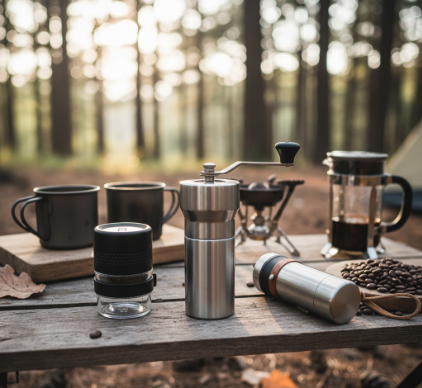
Anyway, modern portable grinders have gotten surprisingly sophisticated. Some have magnetic catch cups that won’t spill even if you drop them (tested accidentally multiple times). Others fold into compact shapes that fit in your pot, nesting like Russian dolls of caffeine delivery systems.
The weight factor matters if you’re backpacking serious distances—my grinder is 180 grams, compared to maybe 850 for a full-size kitchen version—and every gram counts when you’re climbing switchbacks in the afternoon heat wondering why you didn’t just stay home. But then you reach your campsite, boil water over your camp stove, grind beans while watching the sun set behind distant peaks, and brew something that actually tastes like coffee instead of brown regret. It’s worth the extra weight, I guess. Most things that make camping tolerable usually are.