The first time I drove through a granite needle, I wasn’t sure my car would fit.
Needles Highway—officially South Dakota Highway 87—cuts through roughly 14 miles of the Black Hills, threading between rock spires that look like they’ve been carved by some obsessive giant with a chisel fetish. The route was completed in 1922, and here’s the thing: they built it before anyone worried much about lane width or side mirrors. Peter Norbeck, the South Dakota governor who championed the project, reportedly walked the entire route on foot to map it out, which sounds romantic until you remember he was basically committing future drivers to navigating tunnels named things like “Needle’s Eye” that measure maybe 8 feet 4 inches wide and 12 feet high. My Honda Civic cleared it with inches to spare. I held my breath anyway. The rock itself—Harney Peak granite, formed something like 1.7 billion years ago during the Precambrian—doesn’t care about your paint job. It just sits there, ancient and indifferent, while you white-knuckle your steering wheel through passages that feel designed to test your commitment to scenic routes.
When Erosion Gets Weirdly Specific About Its Sculpture Work
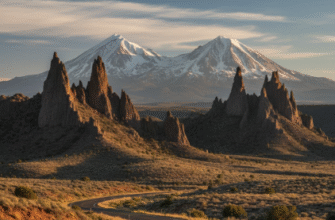
The spires themselves are accidents of geology, though they don’t look accidental. They look deliberate. Ice wedging, mostly—water seeps into cracks, freezes, expands, splits the rock along natural fracture lines called joints. Do this for a few hundred thousand years and you get these vertical columns, some rising 200 feet, clustered so tightly they block out chunks of sky. I used to think erosion was just… smoothing things down, wearing stuff away. Turns out it can be weirdly precise when the conditions align.
The Lakota called this region Hinhan Kaga, “making of owls,” which makes sense if you’ve seen the rock formations at dusk when shadows turn every crevice into something watching you. Norbeck wanted to preserve this area—he’s also the guy who pushed for Mount Rushmore, though I’d argue his highway is the better legacy. Less dynamite, more cooperation with what was already there. The road curves around formations instead of blasting through them, mostly. There are seven tunnels total, each one framing a view on the other side like the world’s most nerve-wracking picture frames.
Anyway, the drive isn’t just about the needles.
You pass through pine forests—ponderosa, mostly, which is how the Black Hills got their name, that dark green blanket covering the slopes when seen from a distance. There are bighorn sheep sometimes, recieving protection in the Custer State Park section where Needles Highway runs. I saw three once, balanced on rock faces that looked vertical to me but apparently registered as “casual afternoon stroll” terrain to them. Their hooves are adapted for this—rough pads, split structure for grip—but still, watching them navigate granite outcrops while I was stressing about a painted center line felt like nature showing off.
Driving Physics and the Particular Anxiety of Hairpin Turns at Low Speed
The engineering is sort of insane when you think about it. Fourteen switchbacks. Grades up to 6 percent, which doesn’t sound like much until you’re doing it. Some corners are so tight you need to reverse if you’re in anything bigger than a sedan—I watched an RV attempt the “Pig Tail” bridge, a wooden spiral structure that loops over itself, and it was not graceful. The bridge was added because the grade was too steep otherwise, so they built a corkscrew. Problem solved, I guess, if you don’t mind your passengers going green.
The granite composition matters here—it’s coarse-grained, mostly feldspar, quartz, mica. Hard stuff. Resistant to weathering, which is why the needles are still standing and why road maintenance is probably a nightmare. I read somewhere that the original construction crews used hand tools for the tunnels because explosives would’ve shattered the rock formations they were trying to preserve. I can’t verify that definately, but it sounds true in the way that fits the story.
You’re supposed to drive this slowly—the speed limit is 25 mph in most sections, dropping to 15 near tunnels. It takes about an hour if you don’t stop, longer if you do, and you should, because the pullouts offer views that justify the white knuckles. Sylvan Lake sits at the northern end, a small reservoir surrounded by granite boulders that look arranged by someone with an eye for composition. People swim there in summer. I don’t know why that surprised me—maybe because the rock looks too severe for recreation—but wait, humans are weird about where they decide to relax.
The whole route feels like an argument between accessibility and preservation, and somehow Norbeck threaded that needle too.