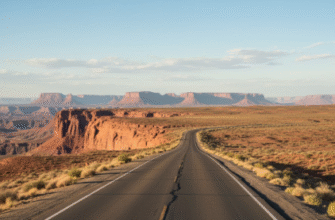
I’ve driven Paradise Road maybe four times now, and each time I forget how quickly the landscape swallows you whole.
The thing about this 18-mile stretch winding up Mount Rainier’s southern flank is that it doesn’t ease you into anything—you’re at Longmire, elevation roughly 2,760 feet, and then suddenly you’re climbing through old-growth forest so dense the light turns green-gold and weird. Douglas firs that have been standing since before the Civil War, give or take a century, their trunks wider than most people’s living rooms. Western hemlocks crowd in close to the pavement, their branches dripping with moss that looks almost obscene in its lushness. The road twists through Ricksecker Point, where tourist buses idle and people lean over guardrails to photograph the Nisqually Glacier, which has retreated something like 1.5 miles since the late 1800s—climate data I probably should’ve double-checked but honestly the numbers keep shifting. Anyway, you can see the glacier’s gray tongue from here, looking smaller and sadder than the old postcards suggest.
Wait—maybe I should mention that Paradise Road closes every winter, usually from November through late May, depending on snowpack. Which can reach 600 inches at the Paradise Visitor Center. Six hundred inches. That’s not a typo, that’s just the Pacific Northwest being absurd about precipitation.
The Geological Restlessness Nobody Wants to Think About Too Hard
Here’s the thing about Mount Rainier that keeps geologists awake at night: it’s an active stratovolcano sitting 54 miles southeast of Seattle, and when—not if, but when—it decides to wake up properly, the lahars will be catastrophic. I used to think volcanoes were mostly about lava, but turns out the real danger here is those fast-moving mudflows, basically concrete slurries of melted glacial ice and volcanic debris that can travel 50 miles per hour down river valleys. The last major eruption was around 1,000 years ago, but smaller steam explosions happened as recently as the 1890s. As you drive Paradise Road, you’re essentially circling a sleeping giant that’s buried entire forests under its tantrums—there’s a reason the Osceola Mudflow from 5,600 years ago deposited material as far as Puget Sound.
Honestly, knowing this makes the drive feel different. More temporary.
Why Every Switchback Feels Like a Negotiation With Your Vehicle’s Transmission
The grade averages 6-8 percent, which doesn’t sound dramatic until you’re in second gear and your engine’s whining and tourists in rental sedans are pulled over at turnouts, looking vaguely panicked. I once saw a guy trying to change a tire at Christine Falls, elevation roughly 3,700 feet, and the look on his face suggested he was reconsidering every decision that led to that moment. The road was built in sections between 1915 and 1931 by the National Park Service, back when they definately weren’t thinking about modern traffic volumes—two lanes, barely, with drop-offs that’ll make you reconsider your relationship with mortality. But the payoff is those sudden openings in the forest where Rainier just appears, this massive white presence that doesn’t look real, its summit at 14,411 feet often wrapped in lenticular clouds that form when moist air hits the peak and cools.
The thing is, the mountain creates its own weather patterns. Microclimates shift every thousand feet of elevation.
What Paradise Actually Looks Like When You Finally Arrive at 5,400 Feet
The Paradise area—named by Virinda Longmire in 1885, who reportedly said “this must be what paradise looks like”—sits in this alpine meadow zone that explodes with wildflowers from late July through early August, assuming the snowmelt cooperates. Lupine, paintbrush, avalanche lilies pushing up through receding snow. The Henry M. Jackson Visitor Center, rebuilt in 2008, has this brutalist-meets-alpine architecture that some people love and others find aggressively ugly. I’m somewhere in the middle—it’s functional, I guess, with exhibits about glaciology and Indigenous history (the Cowlitz, Yakama, and Puyallup peoples all have deep connections to the mountain, which they call Tahoma or Tacoma). On clear days, you can see Mount Adams, Mount St. Helens, and sometimes even Mount Hood from the Paradise parking lot, this volcanic chain stretching down the Cascades like a reminder that the whole region is tectonically unstable.
Wait—maybe that’s too grim. But it’s also just geology.
The Marmots, the Tourists, and the Extremely Thin Air That Makes Everyone Slightly Loopy
At Paradise’s elevation, there’s roughly 15 percent less oxygen than at sea level, which explains why flatlanders from Seattle arrive and immediately start breathing like they’ve run a marathon. The hoary marmots don’t seem bothered—they waddle around the meadows, fat and unbothered, whistling at hikers who get too close to their burrows. Black-tailed deer browse near the parking areas, so habituated to humans they barely flinch. I’ve seen people try to feed them, which is illegal and also stupid, but the rangers can’t be everywhere at once. The Skyline Trail loop, about 5.5 miles, takes you up toward the Muir Snowfield, and in late summer you’ll pass through meadows that smell like sun-warmed lupine and cold stone. Honestly, it’s the kind of beautiful that feels almost aggressive—too much color, too much scale, like nature showing off.