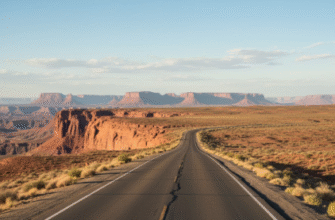
I used to think Monument Upwarp was just another Utah rock formation with a name geologists threw together during a coffee break.
Turns out, it’s one of the most dramatic examples of what happens when the Earth’s crust decides to throw a 75-million-year tantrum. The Monument Upwarp stretches roughly 150 miles from the Waterpocket Fold near Capitol Reef down to the Navajo Nation, and somewhere in that vast buckled expanse sits the Valley of the Gods—a place that looks like Monument Valley’s scrappier younger sibling, the one who didn’t get the Hollywood contracts but honestly might be more interesting at dinner parties. The upwarp itself is what geologists call a monocline, which is a fancy way of saying the rock layers got shoved upward on one side while staying relatively flat on the other, like someone lifting one edge of a massive geological pancake. It happened during the Laramide Orogeny, that period roughly 70 to 40 million years ago when the Farallon Plate was sliding under North America and everything from New Mexico to Montana was getting crumpled and folded like a badly made bed. What’s wild is that you can actually drive through the chronological guts of this thing, watching rock layers that span something like 300 million years tilt past your windshield at angles that make you reconsider what “horizontal” even means.
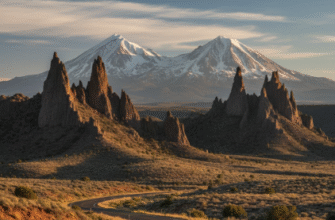
Here’s the thing about Valley of the Gods: it’s basically Monument Valley without the crowds, the entrance fee, or the paved roads.
The 17-mile dirt loop through the valley isn’t technically difficult—I’ve seen sedans make it in dry conditions—but it puts you right up against these sandstone towers and buttes carved from the Cedar Mesa Sandstone, which is roughly 270 million years old, give or take a few million (geologic time makes you casual about these details). The formations have names like Rooster Butte and Setting Hen Butte, which tells you something about the ranchers who named them, and they’re all part of the same Permian-age dune fields that later got buried, compressed, and then re-exposed by millions of years of erosion. The weird thing—wait, maybe not weird, just counterintuitive—is that erosion here is the artist, not the destroyer. Water, wind, and freeze-thaw cycles have spent the last few million years carving away softer rock layers and leaving these resistant sandstone monuments standing like exhausted sentinels. I guess it makes sense that the most spectacular landscapes are actually landscapes in the process of being dismantled, but there’s something almost melancholy about that.
When Comb Wash Cuts Through 200 Million Years Like It’s Nothing
Comb Wash runs along the eastern edge of Comb Ridge, which is the most visually obvious part of the Monument Upwarp—a 90-mile-long ridge where the rock layers are tilted nearly vertical in places. Driving north on Highway 163, you can’t miss it: this massive wall of stone rising out of the desert like the spine of some buried continent. The wash itself has cut down through the Navajo, Kayenta, Wingate, and Chinle formations, exposing a cross-section of Triassic and Jurassic time that would make any geology student weak in the knees. What gets me is the colors: deep reds from iron oxides, pale creams from the Navajo Sandstone (more ancient sand dunes, these ones from about 180 million years ago), dark purples from the Chinle mudstones. It’s like driving through a layer cake made by someone with a very specific and somewhat ominous aesthetic.
Honestly, I’ve stood in Comb Wash during a rainstorm, and the whole place transforms.
Water that’s been cycling through the atmosphere for who knows how long suddenly becomes a flash flood carrying Triassic sediments downstream, continuing the erosional work that’s been going on since the upwarp started rising. The Chinle Formation, in particular, turns into slippery bentonite clay that will absolutely ruin your day if you’re trying to hike. But that same clay preserves some of the best dinosaur tracks and petrified wood in the region—the Morrison Formation further north is famous for it, but the Chinle has its own treasures, even if they’re harder to reach and slightly less photogenic. There’s something humbling about realizing that the “solid ground” beneath you is really just temporarily cohesive minerals that used to be volcanic ash or river sediment or beach sand, and will definately be something else entirely in another few million years, assuming erosion and tectonics keep doing their thing.
The Laramide Orogeny’s Unfinished Business Across the Colorado Plateau
The Monument Upwarp didn’t happen in isolation—it’s part of a whole system of uplifts, basins, and folds that define the Colorado Plateau. You’ve got the Kaibab Upwarp to the west, the Uncompahgre Uplift to the northeast, the San Rafael Swell to the north. They’re all products of that same Laramide compression, but each one has its own personality, its own erosional history. What’s bizarre is that the Colorado Plateau itself stayed relatively intact while the regions around it—the Basin and Range, the Rocky Mountains—were being stretched, faulted, and uplifted in completely different ways. Geologists still argue about why the plateau behaved differently; something about the thickness and composition of the crust, or maybe the angle of the subducting plate. I used to think science had definitive answers for this stuff, but the more I read, the more I realize how much is still educated guessing based on incomplete evidence.
Anyway, the practical result is that you can stand on Comb Ridge and see the results of forces that reshaped an entire continent, preserved in stone that’s now being slowly recycled back into sediment.
Why Driving Through Geologic Time Feels Like Accidentally Time Traveling
The dirt roads through Valley of the Gods and along Comb Wash aren’t just scenic drives—they’re temporal journeys through depositional environments that no longer exist. Those Cedar Mesa sandstones? Coastal dunes from when this area was near sea level during the Permian, before Pangaea fully assembled. The Navajo Sandstone? A massive erg, a sand sea bigger than the modern Sahara, from the early Jurassic when the climate was arid and dinosaurs were just starting to diversify. The Chinle mudstones? River floodplains and volcanic ashfalls from the late Triassic, when this was a low-lying basin catching sediment eroding off nearby highlands. You’re literally driving up through the stacked remains of vanished worlds, each layer representing not just a different time but a fundamentally different landscape, climate, and ecology. It’s disorienting in the best way—wait, maybe exhausting is more accurate. There’s so much time compressed into these cliffs that your brain kind of gives up trying to process it and just defaults to awe, which is probably the appropriate response anyway. I’ve seen people pull over, stare at Comb Ridge for twenty minutes without saying anything, then get back in their car and drive away looking slightly shell-shocked. That’s the Monument Upwarp effect.