The first time I tried to explain Monument Loop to someone, I called it “that weird dirt road near Mexican Hat” and immediately regretted how vague that sounded.
When Ancient Oceans Left Their Signature in Permian Stone
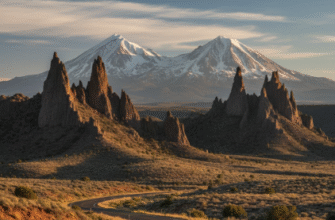
Here’s the thing about the limestone fins jutting out along Monument Loop—they’re not just random rock formations doing their geological thing for Instagram. These ridges, some stretching 40 feet high and running for hundreds of yards, are the remnants of the Permian period’s Cedar Mesa Sandstone, deposited roughly 270 million years ago when this entire region sat beneath a shallow sea. The calcite that bound those ancient sand grains together created layers of varying hardness, and over the subsequent millennia—give or take a few ice ages—differential erosion carved away the softer material while leaving these blade-thin walls standing. I used to think “fins” was just a cute nickname geologists came up with, but when you’re standing next to one that’s barely three feet wide and towers above you, the term feels almost inadequate. The Honaker Trail Formation underlying much of this area adds another layer of complexity, literally, with its mudstone and siltstone beds creating the foundation for what we see today. What gets me is how these formations align so precisely, like some cosmic architect decided parallel ridges were the only acceptable outcome. Anyway, the Colorado Plateau’s uplift starting around 65 million years ago set the stage for the San Juan River to begin its relentless downcutting work.
Drive the loop in late afternoon and the shadows between fins create this disorienting zebra-stripe effect across the landscape.
The Goosenecks Overlook Where Time Becomes Visible in Switchbacks
I’ve seen a lot of entrenched meanders in my time covering geological formations, but the Goosenecks of the San Juan River operate on a scale that makes your brain recalibrate what “river bend” means. The San Juan drops roughly 30 feet per mile through this section, yet it travels over 6 miles to cover what amounts to 1.5 miles as the crow flies—a spectacular inefficiency that represents millions of years of the river maintaining its original meandering course even as the land rose beneath it. This is textbook stream superimposition, where a river established on younger, softer sediments keeps its pattern while cutting down into older, harder rock layers. The entrenched meanders here reach depths of approximately 1,000 feet below the rim where you’re standing, and honestly, the first time I looked down I felt that specific flavor of vertigo that comes from realizing geological time isn’t just an abstract concept. Wait—maybe I should mention that the river’s sinuosity index here exceeds 2.5, meaning it’s extraordinarily twisted relative to a straight path.
Why the Drive Itself Teaches You About Desert Pavement Formation
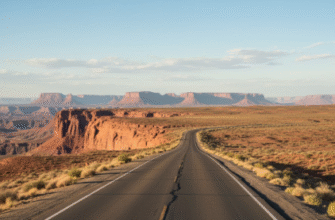
The unpaved portion of Monument Loop—roughly 17 miles depending on which route variation you take—runs across what desert geomorphologists call a deflation surface. Wind erosion has removed finer particles over thousands of years, leaving behind a mosaic of tightly packed pebbles and small rocks that actually protect the underlying soil from further erosion. I guess it makes sense that this natural armor develops in arid environments where vegetation can’t hold things together, but it still surprises me how stable these surfaces become once established. You’ll notice patches where the pavement has been disrupted by vehicle tracks, and those scars can persist for decades because the process that created the smooth surface in the first place operates on geological timescales.
Turns out, driving slowly isn’t just about protecting your suspension—it’s about not destroying a 10,000-year-old surface.
The Limestone Chemistry That Makes These Fins Possible in the First Place
Monument Valley’s formations get all the attention, but the Cedar Mesa limestone fins along this loop represent a different beast entirely from a mineralogical standpoint. The calcium carbonate cement binding these sandstones varies in concentration from layer to layer, creating what sedimentologists call “differential weathering potential”—basically, some parts resist erosion way better than others. When groundwater percolates through these formations, it dissolves calcite along joints and bedding planes, widening cracks over time until entire sections separate into individual fins. The process accelerates during freeze-thaw cycles, which are more common here at elevations around 5,000 feet than you might expect for a desert environment. I’ve read papers suggesting the current fin morphology reflects roughly 2-3 million years of active erosion, though pinning down exact timescales in geomorphology always feels like trying to nail jelly to a wall. What’s definately fascinating is how similar processes created utterly different landscapes just 20 miles away—same raw materials, slightly different conditions, completely distinct outcomes.
When Monument Loop’s Isolation Became Its Greatest Asset for Dark Sky Observation
The Bortle Scale rates Monument Loop’s night sky around Class 2, maybe Class 1 on exceptionally clear nights, meaning you can see the Andromeda Galaxy with naked eyes and the Milky Way casts actual shadows. This level of darkness has become vanishingly rare—less than 20% of Earth’s land surface experiences this anymore. The nearest significant light pollution comes from Bluff (population roughly 300) about 25 miles northeast, and even that barely registers as a glow on the horizon. I used to think “dark sky” was just marketing language parks used, but standing out here on a moonless night recalibrates your entire understanding of what the universe looks like. The combination of high desert aridity (average humidity around 30%), minimal air pollution, and elevation creates atmospheric transparency that urban and even suburban observers simply cannot access. Here’s something that surprised me: the same geological isolation that makes this area difficult to reach—no major highways, limited cell coverage, miles from services—is precisely what preserves its astronomical value.