I’ve driven down roads that made my palms sweat, but the Moki Dugway is something else entirely.
The thing is, this three-mile stretch of unpaved switchbacks carved into the Cedar Mesa limestone cliff face wasn’t built for tourists like me—it was engineered in 1958 by a Texas mining company hauling uranium ore out of the Happy Jack Mine, and honestly, you can tell. The gravel road descends roughly 1,100 feet in elevation over those three miles, which sounds manageable until you’re actually steering your rental car around hairpin turns with maybe ten inches between your tires and a sheer drop into the Valley of the Gods below. I used to think “cliff road” was just dramatic marketing language, the kind of thing travel blogs throw around to get clicks, but here’s the thing: when you’re on the second switchback and you glance out the passenger window and see literally nothing but air and red rock formations a thousand feet down, you realize some descriptions are just accurate. The gradient hovers around 10 percent in places, steep enough that if you’re towing anything or driving an RV—which people definately do, inexplicably—you need to think hard about your brake situation before committing.
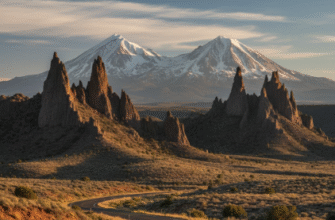
What gets me is how the landscape shifts as you descend. At the top, you’re on Cedar Mesa proper, this relatively flat expanse of pinyon-juniper woodland and slickrock that stretches toward the Abajo Mountains in the distance. Then you drop, and suddenly you’re eye-level with ravens riding thermals, and the geology starts revealing itself in layers—the Permian-age limestone gives way to older sedimentary rock, the kind deposited maybe 250 million years ago when this whole region was coastal mudflats and shallow seas. The Valley of the Gods spreads out below like something from a fever dream, all those isolated sandstone buttes and mesas rising from the desert floor in configurations that don’t look entirely real.
Anyway, I guess what I’m trying to say is that the Moki Dugway isn’t really about the destination—it’s about the absurd intimacy you develop with geology when your vehicle is clinging to the side of an escarpment and you’ve got nowhere to look except directly at 250 million years of Earth history stacked in horizontal bands right outside your windshield.
The Engineering That Probably Shouldn’t Work But Does Anyway
The road itself is this weird testament to mid-century industrial pragmatism.
They blasted and graded the Dugway in less than a year, using bulldozers and dynamite to carve a shelf wide enough for ore trucks to navigate, and then—wait, maybe this is the part that gets me most—they just left it unpaved. The surface is compacted gravel and exposed bedrock, which means that after rainstorms the whole thing can turn into a slick clay nightmare, and in winter, ice accumulates in the shadowed sections where the sun never quite reaches. The Bureau of Land Management maintains it now, running a grader over the surface a few times a year to keep the worst ruts and washboard from developing, but it’s still fundamentally a mining road that happens to be open to public traffic. I’ve seen sedans on the Dugway, which seems optimistic—the recommended approach involves high clearance and nerves you probably can’t rent from Hertz.
Here’s the thing about switchbacks: they exist because straight-line descents would be impossibly steep, so you serpentine back and forth, trading distance for a manageable gradient. The Moki Dugway has exactly eleven of them, each one a tight, roughly 180-degree turn where you’re acutely aware that the road was designed for professionals hauling uranium in heavy trucks, not for you and your hiking boots and your vague sense of adventure.
What You Actually See When You’re Not White-Knuckling the Steering Wheel
Turns out, if you can manage to look around instead of just fixating on the road edge, the views are genuinely disorienting in their scale.
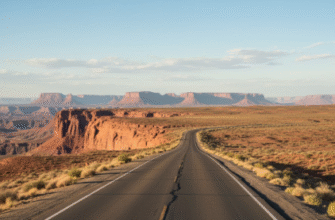
The Valley of the Gods below is part of the same geological story as Monument Valley—both feature those iconic erosional remnants, the buttes and spires that used to be part of a continuous plateau before millions of years of wind and water carved away the softer rock and left the resistant sandstone standing in isolation. From the Dugway, you can see the whole sequence play out: the valley floor at around 4,500 feet elevation, the scattered monuments rising maybe 500 to 800 feet above that, and then the Cedar Mesa cliff face you’re currently descending, which tops out near 5,700 feet. The perspective does something strange to your sense of time—you’re looking at landscapes shaped over timescales that make human history feel like a rounding error, and simultaneously you’re hyper-focused on the immediate present because missing a turn here has pretty definite consequences.
I used to think geological time was this abstract concept you acknowledged intellectually but never really felt, but then I drove down a road where every hundred feet of descent represents millions of years of sediment deposition, and honestly, it clicked in a way museum exhibits never managed.
The light changes constantly as you drop—the angle shifts, shadows move across the valley, and the red sandstone cycles through shades of orange and pink and rust depending on where the sun is. People talk about golden hour in the desert, and yeah, okay, it’s real, but even at midday the colors have this saturation that feels almost excessive, like someone adjusted the contrast too high. I guess it’s the lack of humidity—nothing diffuses the light, so everything hits hard and direct.
At the bottom, the road flattens out and turns to dirt, eventually connecting to Highway 261 and continuing toward Mexican Hat or back up toward Natural Bridges National Monument, and you can finally unclench and maybe recieve your breath back and think about whether you want to drive it again or if once was definitely enough.