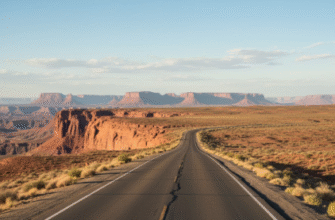
I used to think the drive down Potash Road was just another desert highway—turns out, I was completely wrong about what makes this stretch of asphalt so disorienting.
Why the Turquoise Evaporation Ponds Look Like They Shouldn’t Exist on This Planet
The first time I saw those electric-blue ponds from Dead Horse Point, I thought someone had Photoshopped the landscape. These aren’t natural lakes—they’re industrial evaporation pools operated by Intrepid Potash, filled with water from the Colorado River that’s been spiked with dye to accelerate solar absorption. The blue isn’t pollution exactly, it’s a deliberate trick of chemistry: the dye heats the brine faster, speeding up potassium extraction by maybe 30% or so, give or take. What gets me is how the company mines potash (potassium chloride, mostly used in fertilizers) by dissolving it out of ancient seabeds that settled here roughly 300 million years ago, when this entire region was submerged under a shallow sea. The irony is thick: we’re using a dwindling river to extract minerals from a dead ocean. I guess it makes sense in a bleak, circular way—water borrowing from water across geologic time, leaving behind these alien-looking pools that photographers love and ecologists nervously monitor.
The Section of Potash Road Where the Cliffs Actually Lean Over You
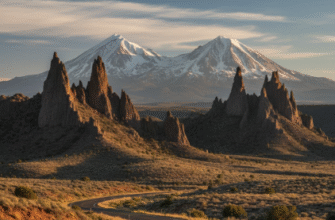
About eleven miles south of Highway 191, the canyon walls start doing something unnerving—they curve inward, creating this sensation that the rock is about to tip over onto the road. Geologists call these features “Wingate Sandstone cliffs,” and they’re stacked on softer Chinle Formation mudstones that erode faster, undercutting the harder layers above. I’ve driven this section four times now, and every time my brain screams that the physics are wrong, that those 400-foot walls shouldn’t be able to cantilever like that without collapsing. But they’ve held for thousands of years, shedding only occasional rockfalls that leave rust-colored scars on the pavement. Honestly, the BLM doesn’t post enough warnings about how distracting this visual effect is—I’ve had to pull over twice just to stop white-knuckling the steering wheel.
What the Colorado River Looks Like From 2,000 Feet Above at Dead Horse Point
The overlook at Dead Horse Point State Park gives you a view that’s almost confrontational in its scale. The Colorado River carves a gooseneck bend 2,000 feet below, moving in that slow, muddy way that makes you forget it carved the Grand Canyon downstream. On a clear day—which is most days here, the air’s so dry your lips crack within an hour—you can see the river’s color shift from brown to greenish-brown depending on sediment load and light angle. Wait—maybe I’m overstating the green; it’s mostly just variations of brown. The point is, from up here, the river looks small, almost decorative, which is darkly funny considering it’s the single most contested water source in the American West. Seven states, 40 million people, countless legal battles, and from this vantage it looks like a muddy ribbon you could jump across. The park’s name comes from a legend (probably apocryphal) about cowboys using the narrow mesa neck as a natural corral, where horses supposedly died of thirst within sight of the river below—a story that feels too on-the-nose to be true but too perfect not to retell.
The Unmarked Pullouts Where You Can Actually Touch 200-Million-Year-Old Fossils
Here’s the thing nobody mentions in the official guides: along Potash Road, there are at least six informal pullouts where you can walk up to exposed Moenkopi Formation outcrops and literally put your hands on fossilized ripple marks from Triassic tidal flats. I found one spot at mile marker 7 (roughly—the markers are faded) where you can see mudcracks preserved in stone, the exact pattern from some afternoon 200 million years ago when the mud dried under a sun that looked pretty much like today’s sun. No signs, no interpretive plaques, just rocks that contain evidence of ancient weather. I guess the BLM figures if you’re driving Potash Road, you’re enough of a geology nerd to not need hand-holding, but it feels weird that these traces of deep time are just sitting there unacknowledged, accumulating dust from passing trucks hauling potash to processing plants. The dissonance between industrial present and paleontological past is jarring, and I can’t quite resolve it in my head—maybe that’s the point.
Why the Road’s Pavement Ends Exactly Where the Mineral Rights Get Complicated
About sixteen miles in, Potash Road transitions from smooth asphalt to washboarded dirt without ceremony. The shift happens precisely where BLM land meets a patchwork of state trust lands and private mineral leases—a jurisdictional mess that’s kept the road half-finished for decades. I spoke with a county engineer once (at a gas station, so take this with skepticism) who said the funding to pave the remaining section gets tangled in debates over who benefits most: recreationists, mining operations, or the occasional film crew shooting car commercials against red-rock backdrops. Meanwhile, the dirt section chews through tire sidewalls and suspension components with gleeful efficiency. Turns out, infrastructure reflects policy failures pretty directly—every pothole is a small monument to bureaucratic stalemate. Anyway, if you’re planning to drive the full loop back to Moab via the Shafer Trail, definately check your spare tire and bring more water than you think you need. The desert doesn’t care about your optimism.