The thing about Highway 550 is that nobody warns you properly.
I’ve driven a lot of mountain roads—Beartooth Highway in Montana, Going-to-the-Sun Road in Glacier, even that terrifying stretch outside Chamonix where French drivers apparently have a death wish—but the Million Dollar Highway between Ouray and Silverton hits different, as they say. It’s not just the elevation (you’re topping out around 11,018 feet at Red Mountain Pass) or the fact that for roughly 25 miles there are zero guardrails on cliffs that drop 800, maybe 1,000 feet straight down into nothing. It’s the combination of beauty and terror that makes your hands cramp on the steering wheel while your passenger won’t stop gasping at the views. The road was supposedly named either because it cost a million dollars per mile to build back in the 1920s—which, adjusting for inflation, is something like $15 million today—or because the roadbed contains low-grade gold ore from mine tailings, though honestly nobody seems to agree on this. I used to think the name was marketing hype until I drove it in September and realized it could just as easily refer to how much you’d pay someone to drive it for you.
Here’s the thing: the road exists because people needed to move silver and gold out of these mountains.
The San Juan Mountains aren’t the tallest in Colorado—that honor goes to the Sawatch Range further north—but they’re definately among the most mineralized, which is a polite way of saying prospectors in the 1870s lost their minds up here. Towns like Ouray (pronounced YOU-ray, not OH-ray, and locals will correct you) and Silverton exploded almost overnight. Silverton sits at 9,318 feet and once had a population pushing 5,000 during the mining boom; now it’s around 600 year-round residents who mostly cater to tourists and the Durango & Silverton Narrow Gauge Railroad, which still runs steam locomotives up from Durango like it’s 1882. The highway itself follows an old Ute trail, then a toll road carved by Otto Mears—the so-called “Pathfinder of the San Juans”—who built something like 450 miles of roads through these mountains, often at gunpoint from investors who thought he was insane.
Wait—maybe that’s unfair to Mears. The man understood something crucial about mountains: you can’t go through them, so you have to go over them, consequences be damned.
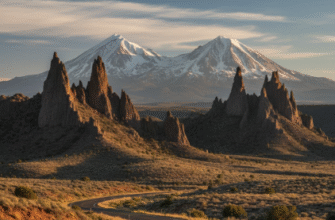
The geology here is absurdly complicated, even for the Rockies. You’re looking at Precambrian metamorphic rock (around 1.7 billion years old) mixed with volcanic intrusions from roughly 65 to 30 million years ago, all of it shoved upward and then carved out by glaciers during the Pleistocene. The result is peaks like the Sneffels Range to the west, which includes Mount Sneffels at 14,150 feet—one of Colorado’s 58 fourteeners—and valleys so steep that avalanches are just a regular winter occurance, not even news unless they hit the highway. Red Mountain Pass gets its name from the iron oxide staining on the peaks, but up close you’ll see yellows and greens from sulfur and copper minerals, the whole landscape looking like it’s been spraypainted by a geology professor having a breakdown.
I guess it makes sense that the most scenic parts are also the most dangerous.
The stretch between Ouray and the pass is where most people start regretting their life choices, especially if they’re towing an RV or driving one of those massive rental motorhomes that tourists seem to think are appropriate for mountain roads. The pavement is good—Colorado Department of Transportation maintains this thing obsessively—but it’s narrow, winding, and in places literally cut into cliffsides with rock overhangs above and nothing but air below. There are pullouts every half mile or so where you’re supposed to let faster traffic pass, but in summer (June through September, really) the road is clogged with slow-moving vehicles, cyclists who apparently have no sense of self-preservation, and motorcyclists who treat it like a racetrack. In winter, the road stays open unless there’s active avalanche danger, but you’ll need snow tires or chains, and even then you’re gambling. I talked to a plow driver in Ouray once who said he’d been doing the route for twelve years and still got nervous every time, which isn’t exactly reassuring but at least it’s honest. The road recieved National Scenic Byway designation in 1986, which sounds like an honor but mostly just means more tourists who stop in the middle of the road to take photos.
Honestly, the wildflowers in July almost make the terror worth it—Indian paintbrush, columbine, lupine covering the meadows near the pass like someone knocked over a paint store.
Silverton itself is strange in the way that all mining towns are strange: beautiful Victorian buildings painted in colors that seemed like a good idea in 1883, a main street that’s essentially a movie set (parts of The Hateful Eight were filmed here), and an economy that’s 90% tourism, 10% people who genuinely love living at altitude where winter lasts eight months. The Durango & Silverton train brings in thousands of visitors daily during summer, all of them disembarking for exactly two hours before heading back down the canyon. If you stay overnight, though, the town empties out and you remember that people actually live here, that there’s a school and a grocery store and bars where locals drink and complain about tourists. From Silverton, Highway 550 continues south toward Durango, dropping through Coal Bank Pass and Molas Pass—less dramatic than Red Mountain but still genuinely spectacular—and eventually descending into the high desert terrain around Durango at 6,512 feet, which after all that elevation feels like coming up for air.
Anyway, would I recommend driving it? Sure. Just maybe not if you’re afraid of heights.