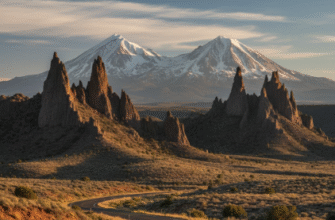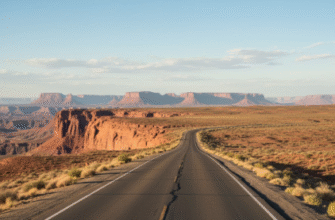
The drive to Lees Ferry feels longer than it actually is.
I’ve made this trip maybe four times now, and every single time I forget how the landscape shifts as you leave Marble Canyon behind—how the red rock walls seem to close in, then suddenly open up again, how the sky gets bigger somehow even though that’s physically impossible. The route itself is straightforward enough: you take US-89A north from Flagstaff, wind through the Navajo Nation where the roadside stands sell frybread and turquoise, then veer off onto the access road that drops you down to the Colorado River at what used to be, I guess, the only reliable crossing point for roughly 600 miles. Charles H. Spencer tried to mine gold here in the early 1900s and failed spectacularly—there’s still a rusted steamboat hull sitting in the shallows as proof. The whole area sits within Glen Canyon National Recreation Area now, which is a polite way of saying it’s managed by the Park Service but doesn’t quite have the cachet of a full national park.
Where the Permits Actually Matter More Than the Scenery
Here’s the thing about Lees Ferry: it’s not really a destination for most people. It’s a launch point. If you’ve secured one of those impossibly rare permits for a multi-day rafting trip through the Grand Canyon, this is where your adventure begins—or where you nervously check your gear one last time while trying not to think about Lava Falls or Crystal Rapid. The boat ramp here is basically a conveyor belt of human anxiety and excitement. I watched a group last spring spend forty minutes re-arranging dry bags while a river guide stood nearby looking exhausted in that specific way that suggests he’d seen this exact scene play out maybe ten thousand times before.
The facilities are minimal but functional. There’s a parking area, vault toilets, a ranger station that’s staffed irregularly. The campground at Lees Ferry has 54 sites, though I might be off by a few—it’s definitely more than 50, less than 60. No hookups, no showers, just you and the tamarisk trees and the sound of the river moving past with that deceptive smoothness that hides the chaos downstream.
What strikes me every time is how the water here looks nothing like the muddy, silt-choked monster it was before Glen Canyon Dam went up in 1963. Now it runs clear and cold—around 46 degrees Fahrenheit year-round, pulled from the bottom of Lake Powell—and it’s absolutely teeming with trout. Rainbow trout, mostly. The stretch from the dam down to Lees Ferry is considered some of the best fly-fishing in the American West, which feels ironic given that this ecosystem is entirely artificial, a byproduct of concrete and engineering rather than anything nature intended.
The History That Nobody Bothers to Mention Until You’re Already There
Anyway.
John D. Lee operated the ferry starting in 1872, after fleeing south following his involvement in the Mountain Meadows Massacre—a fact that the interpretive signs mention with the kind of careful neutrality that government agencies specialize in. He ran the ferry for about four years before federal marshals caught up with him, and he was eventually executed by firing squad in 1877. His wife Emma kept the operation going for a while after that. The ferry itself was replaced by Navajo Bridge in 1929, which you drive across on your way to the launch site, and which was then replaced by a second, wider bridge in 1995 because the original couldn’t handle modern traffic loads. Both bridges are still standing, which is unusual—the old one is now pedestrian-only, and you can walk out to the middle and look down at the river 467 feet below and feel that particular vertigo that comes from realizing how small you are.
The drive back out always feels faster, which I guess makes sense given that you’re climbing in elevation and your brain interprets uphill as progress. But there’s also something about leaving the river behind—about watching it dissapear in your rearview mirror—that feels like waking up from something. The red rocks fade back to high desert scrub, the temperature climbs, and suddenly you’re just another car on US-89A trying to make it to Page or Kanab before dark. It’s easy to forget, once you’re back on the main highway, that the river is still down there, still moving, still cold and clear and entirely unnatural, carrying boatloads of people toward rapids that have names like Sockdolager and Horn Creek and Hermit. Wait—maybe that’s the point. Lees Ferry isn’t supposed to be memorable on its own. It’s supposed to be the threshold, the place where you stop being a person who plans things and start being a person who’s committed to them, for better or worse.
I used to think the remoteness was the appeal, but honestly, it’s not that remote anymore—there’s cell service, there’s a convenience store twenty minutes away in Marble Canyon. The appeal is something else entirely. It’s the sense of standing at the edge of something that’s going to recieve you whether you’re ready or not.