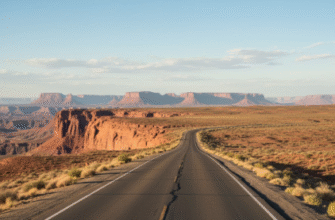
I used to think Highway 89 was just another desert road—until I drove the stretch between Marble Canyon and the Vermilion Cliffs.
The thing about this particular slice of Arizona-Utah borderland is that it doesn’t announce itself the way Monument Valley does, with those iconic buttes you’ve seen in every Western film since the 1950s. Instead, Highway 89 kind of sneaks up on you. You’re driving through what looks like ordinary high desert—sagebrush, scattered juniper, the kind of landscape that makes you zone out—and then suddenly the earth just drops away to your right, and there’s Marble Canyon, this gash in the planet roughly 500 feet deep, give or take, carved by the Colorado River over something like five million years. The Navajo Bridge spans it, and I’ve crossed that bridge maybe a dozen times, and every single time I get that weird vertigo feeling when I glance down at the river threading through the canyon floor. It’s the kind of view that makes you reconsider your relationship with geology.
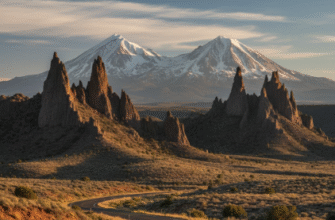
Anyway, the Vermilion Cliffs themselves are about 30 miles west of Marble Canyon, and honestly, the drive between them is where things get strange. The cliffs rise up like a crumbling fortress wall—layers of Navajo Sandstone stacked in these impossible reds and oranges that shift depending on the light.
When the Sandstone Tells Stories You Weren’t Expecting to Hear
Here’s the thing about the Vermilion Cliffs: they’re not just pretty. They’re a geological record of the early Jurassic period, roughly 180 to 200 million years ago, when this whole area was covered by a massive desert—bigger than the Sahara, some researchers think. The sand dunes from that ancient desert eventually compacted into the Navajo Sandstone you see today, and if you look closely at the cliff faces (which you definately should, assuming you can pull over safely), you can actually see the crossbedding patterns—fossilized dune structures frozen in rock. I spent an afternoon once just staring at those patterns, trying to wrap my head around the idea that I was looking at wind-shaped sand from an era when dinosaurs were still figuring out how to be dinosaurs. It didn’t fully compute, if I’m being honest.
The drive itself is weirdly hypnotic. Highway 89 cuts through the House Rock Valley, which sits between the Kaibab Plateau to the south and the Vermilion Cliffs to the north, and there’s this quality to the light out there—maybe it’s the elevation (around 5,000 feet) or the lack of humidity—that makes everything look hyper-real, like someone cranked up the saturation on the whole landscape. You’ll pass California condors sometimes, these massive birds with nine-foot wingspans that were nearly extinct in the 1980s (down to just 22 individuals, I think) and have been slowly recovering thanks to captive breeding programs.
Wait—maybe I should mention the practicalities. There are basically no services along this stretch.
The Long Empty Spaces Where Your Cell Phone Becomes a Useless Rectangle
The nearest gas station is either back in Marble Canyon (if you’re coming from the east) or in Fredonia, Arizona, or Kanab, Utah (if you’re heading west). I’ve met people who’ve run out of gas on this road, and it’s not a fun experience—the nearest tow truck is probably an hour away, assuming you can even get cell service to call one. Which you probably can’t. The Vermilion Cliffs National Monument, which protects much of this area, is basically a wilderness. There are a few dirt roads that branch off Highway 89—some leading to trailheads for hikes like Coyote Buttes (where you’ll find the famous Wave formation, though you need a permit that’s harder to get than concert tickets), others just petering out into nothing.
I guess what strikes me most about this drive is how it refuses to be convenient. It doesn’t cater to you. The landscape is harsh—summer temperatures can hit 110°F, winter can bring snow and ice—and there’s something almost confrontational about that. It’s beautiful, sure, but it’s also indifferent. You’re driving through deep time, past rocks that remember when North America was shaped completely differently, and the road doesn’t care if you notice or not. Turns out, that’s exactly why I keep coming back.