I used to think the best drives were the ones everyone talked about—Pacific Coast Highway, Route 66, that sort of thing.
But here’s the thing: the roads that actually stay with you, the ones that make you pull over just to sit in silence for a minute, are usually the ones nobody’s hashtagging. I’ve spent the better part of a decade chasing down these hidden routes, and I can tell you that the difference between a famous scenic drive and an undiscovered one isn’t the views—it’s the absence of tour buses. Take the Beartooth Highway in Montana and Wyoming, for instance. Sure, some people know about it, but compared to the crowds on Going-to-the-Sun Road, it’s practically deserted. The road climbs to roughly 10,900 feet, give or take, and the tundra landscape up there feels like another planet entirely. You’ll see glacial lakes that nobody’s named yet, or at least nobody’s bothered to put on a map that tourists actually read.
Honestly, I get why most people miss these places. They’re not optimized for Instagram, and the cell service is often nonexistent. But that’s precisely what makes them worth the detour.
The Volcanic Backdoor Through New Mexico’s Jemez Mountain Route
The Jemez Mountain Trail—or NM-4 if you’re being technical—cuts through volcanic calderas and hot springs that most people don’t even know exist. I stumbled onto this one by accident, actually, after missing a turn near Los Alamos. The road winds past the Valles Caldera, a supervolcano that erupted around 1.25 million years ago and left behind this massive, eerily perfect bowl of grassland. There are maybe a dozen cars on this route on a busy day. You’ll pass through Bandelier National Monument, where Ancestral Puebloans carved entire dwellings into the soft volcanic tuff, and then the road just keeps climbing through ponderosa forests that smell like vanilla when the sun hits them right. I guess what strikes me most is how the landscape keeps shifting—desert to alpine meadow to geothermal weirdness—all within maybe 50 miles.
Wait—maybe I’m overstating the supervolcano thing. It’s impressive, sure, but it’s not like Yellowstone where everyone’s waiting for the apocalypse.
Anyway, the hot springs near the end of the route are clothing-optional, which I didn’t realize until it was too late to pretend I hadn’t noticed.
Michigan’s Tunnel of Trees Where Autumn Defies Physics
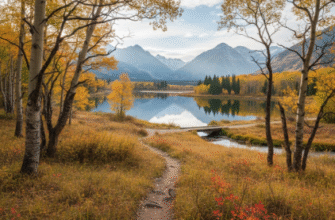
M-119 along Lake Michigan’s northern shore is one of those roads that feels physically impossible during peak fall color. The maples form a literal canopy overhead—hence the name—and when the leaves turn, the light inside your car goes amber and gold in a way that’s almost disorienting. I drove this in late September once, and I had to pull over three times just to recalibrate my sense of reality. The road hugs the Lake Michigan coastline for about 20 miles, twisting through forests so dense you forget you’re near water until suddenly there’s a gap in the trees and the lake’s right there, impossibly blue against the reds and oranges. Most tourists stick to Mackinac Island or Traverse City, which means M-119 stays quiet even in October.
The thing about this drive is that it’s only spectacular for maybe three weeks a year. Miss that window, and it’s just a nice tree tunnel.
Utah’s Burr Trail Switchbacks That Redefine Verticality
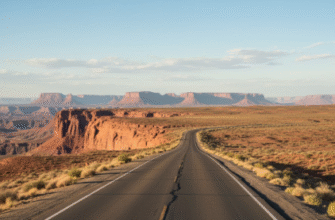
The Burr Trail isn’t technically hidden—it’s on maps—but the western section through the Waterpocket Fold is so remote that it might as well be on Mars. I mean, you’re hours from anything resembling a gas station, and the road transitions from pavement to graded dirt without warning. The switchbacks are what get you, though. They’re carved into pale Navajo sandstone, and they descend—or ascend, depending on your direction—through layers of geological time that span roughly 200 million years. You can see the strata change color as you drop: cream to pink to deep rust. Turns out, this fold is part of the same uplift that created Capitol Reef, but almost nobody drives out here because it requires committing to the remoteness. There’s no cell service, no amenities, just you and the rock and the ocasional raven that looks at you like you’re the weird one for being out here.
I’ve driven this four times now, and I still can’t quite process the scale of it. The human brain isn’t really built for geology on this timescale.
Oregon’s McKenzie Pass Lava Fields That Swallowed the Forest
Highway 242 over McKenzie Pass is closed half the year due to snow, which automatically filters out most tourists. When it is open—usually July through October—you’re driving through a lava field that erupted maybe 1,500 years ago and just… stopped. The trees haven’t grown back. It’s all black basalt and twisted volcanic rock, with the Cascade peaks rising up on both sides like they’re supervising. There’s an old stone observatory at the summit called Dee Wright Observatory, built in the 1930s by the Civilian Conservation Corps, and from there you can see roughly seven or eight volcanic peaks depending on the weather. I say roughly because the visibility shifts and sometimes Mount Jefferson vanishes entirely into clouds while the Sisters stay crystal clear. The road itself is narrow and winding, definately not RV-friendly, which keeps the traffic manageable. What gets me every time is the silence up there—no birds, no wind through trees, just the occasional crack of rock adjusting to temperature changes.
I guess it makes sense that fewer people come here. It’s not pretty in the traditional sense. It’s stark and a little hostile and absolutely stunning if you can sit with the discomfort of it.