I used to think desert towns were all the same—flat, brown, forgettable.
Then I drove through Green River, Utah, and realized I’d been wrong about pretty much everything. The town sits wedged between the Book Cliffs to the north and the San Rafael Swell to the south, right where the Green River cuts through layers of Navajo sandstone that have been sitting there for roughly 200 million years, give or take a few epochs. The Book Cliffs themselves stretch for about 200 miles from central Utah into Colorado, forming this massive escarpment that rises nearly 2,000 feet in some places—geologists love them because you can literally see the Cretaceous period exposed in cross-section, coal seams and all. Green River the town has maybe 950 people, depending on the season, and it exists mostly because John Wesley Powell stopped here in 1869 before his expedition down the Colorado River, though honestly the melon farming probably kept it alive longer than Powell’s fame did. The watermelons here are weirdly legendary, celebrated every September at a festival that feels both earnest and slightly absurd.
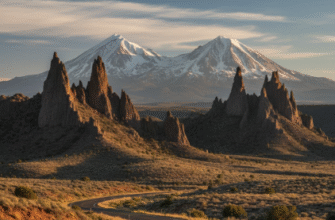
Anyway, the scenic drive is where things get interesting. State Route 19 runs north from Green River toward the Book Cliffs, and if you take it around sunset the light does this thing where it turns the cliffs into layers of orange, rust, and purple that don’t look real. I’ve driven it three times now and I still can’t quite capture it on camera—the colors shift faster than you’d expect.
The Book Cliffs Are Not Actually Cliffs in the Way You’d Expect Them to Be
Here’s the thing: the Book Cliffs aren’t a single dramatic drop like you see in Yosemite or something. They’re more like a series of steep slopes and benches, carved by millions of years of erosion from what used to be an inland sea called the Mancos Shale Sea during the Late Cretaceous, roughly 80 million years ago when dinosaurs were still wandering around down below. The “cliffs” are actually the resistant sandstone caps sitting on top of softer shale and mudstone, which erodes faster and creates these weird tiered formations. Paleontologists have found turtle fossils, crocodile teeth, and even small dinosaur bones in the shale layers—mostly hadrosaurs and ceratopsians that apparently didn’t mind swampy coastlines. The coal seams you see striping the cliffs are compressed vegetation from ancient swamps, and some of them are still being mined today, which feels both practical and vaguely unsettling when you’re staring at geologic time spread out in front of you like a textbook diagram.
I guess it makes sense that a place this visually chaotic would feel hard to pin down.
The river itself—wait, maybe I should back up. The Green River is a major tributary of the Colorado, running about 730 miles from Wyoming down through Utah, and by the time it reaches Green River town it’s already carved through the Uinta Basin and picked up enough sediment to turn a muddy jade color that definately doesn’t match its name. Rafters put in here for multi-day trips through Labyrinth Canyon and Stillwater Canyon, both of which are deeper into Canyonlands National Park, and the put-in spot at Green River State Park is always cluttered with trucks, trailers, and people arguing about permits. The current moves at maybe 2-3 miles per hour through town, slow enough that you can watch ravens dive-bombing the cottonwoods along the banks, but it picks up speed downstream where the canyon walls close in. John Wesley Powell described it as “a quiet stretch” before things got dangerous, and you can still feel that same uneasy calm when you stand on the riverbank at dusk, listening to the water slide past in the dark.
The Drive Itself Is Less About Destination and More About the Disorienting Scale of Empty Space
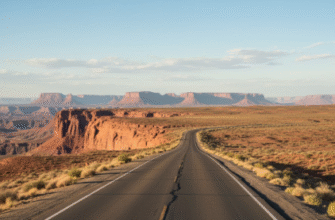
You leave Green River heading north on Route 19 and within ten minutes you’re surrounded by nothing—no buildings, no trees, just sagebrush and rabbitbrush stretching toward the cliffs. The road climbs gradually through bentonite hills that turn into sticky gray mud when it rains, which is rare but catastrophic for tires. Most people drive this route to reach the San Rafael Swell or to connect to I-70, but if you pull off at one of the unmarked dirt turnouts and just sit there, the silence is startling. I’ve seen golden eagles hunting jackrabbits out here, red-tailed hawks perched on fence posts that seem to serve no purpose, and once a coyote that looked directly at me with what I can only describe as tired indifference. The scale messes with your depth perception—the cliffs look close but they’re miles away, and the sky takes up more visual space than the land, which makes you feel smaller than you’d prefer to admit. Turns out, that feeling is kind of the point.