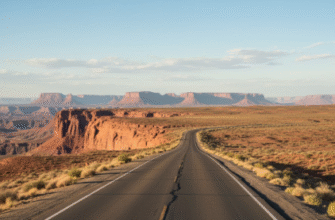
I used to think deserts were just empty.
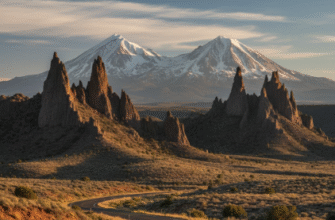
Then I drove Highway 12 between Escalante and Boulder, Utah, and realized I’d been spectacularly wrong about what “nothing” actually looks like. The Grand Staircase-Escalante National Monument—all 1.9 million acres of it, give or take—stretches out in layers of geological time you can literally see from your car window, assuming you’re not white-knuckling the steering wheel too hard to look. The road snakes across the top of what locals call the Hogback, a knife-edge ridge where the pavement drops off on both sides into arroyos that plunge maybe 800, 900 feet down. There’s no guardrail for a solid stretch, which seems like an oversight until you realize this whole landscape was basically an afterthought in terms of human habitation, carved by the Escalante River over roughly 50 million years of patient erosion. The pink and cream-colored Navajo sandstone—same stuff that makes up Zion’s cliffs about 80 miles west—forms these bulbous domes that look weirdly biological, like the desert’s trying to grow tumors. You’ll pass maybe three cars in an hour. It’s that remote.
Wait—maybe “remote” isn’t even the right word. Isolated? The town of Boulder had fewer than 250 people last I checked, and it wasn’t connected by paved road to the rest of civilization until 1940. Nineteen forty. My grandparents were alive then.
When the Plateau Decides to Remind You Who’s in Charge
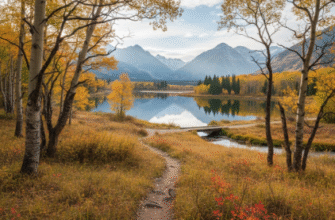
Here’s the thing about Boulder Mountain, which looms over this whole route like some sleeping giant: it’s not techinically part of the Grand Staircase proper, but you can’t seperate the two in your mind once you’ve driven this. The Aquarius Plateau—Boulder Mountain’s just the northern bit—tops out around 11,000 feet, which means you’re climbing from sagebrush desert at 5,500 feet up through ponderosa pine and aspen forests that look like they belong in Colorado, not southern Utah. The cognitive dissonance is real. I’ve seen elk up there in July while it was 103 degrees down in Escalante. The whole drive takes maybe 90 minutes without stops, but you’d be insane not to pull over every ten minutes because the views shift that dramatically. Geologists love this area because you’re essentially driving up through the layers of the Grand Staircase—those massive, color-coded steps of sedimentary rock that descend from Bryce Canyon down to the Grand Canyon. The Chocolate Cliffs, the Vermillion Cliffs, the White Cliffs—they’re all visible from different points along Highway 12, though honestly the names feel a little cutesy for something this overwhelming.
The Bureau of Land Management estimates fewer than 800,000 people visit this monument annually, compared to Zion’s 4.5 million. Turns out obscurity has its perks.
Anyway, the remoteness isn’t just aesthetic—it’s functional, brutal even. Cell service is a joke. The nearest hospital is in Panguitch, maybe 60 miles northwest, longer if you’re coming from Boulder. Flash floods can close the road with maybe 20 minutes’ warning during monsoon season, which runs roughly July through September. I guess what I’m trying to say is this isn’t a drive you do casually.
The Part Where Geology Becomes Uncomfortably Personal
I’ve thought a lot about what it means to look at 200 million years of deposited sediment—ancient sand dunes, petrified, now forming these massive crossbedded cliffs—and feel something like vertigo, but in time instead of space. The Entrada formation, the Carmel formation, the Kayenta—they’re stacked like a layer cake some careless god left out in the rain for a few epochs. Edward Abbey wrote about this area in the ’70s with his characteristic misanthropy, but even he seemed to run out of words for the scale. Honestly, I get it. You’re driving along, and suddenly the landscape cracks open into the Calf Creek drainage, and you can see maybe 30, 40 miles of absolutely nothing human except the ribbon of asphalt you’re on. It’s exhausting, in a way that feels almost cleansing. The light at sunset turns the whole escarpment this insane shade of orange-pink that photographers call “alpenglow,” though that term feels imported from somewhere less alien than this.
There’s a pullout near the Hogback where I sat for maybe 45 minutes once, just watching the shadows lengthen across the slickrock. Didn’t take a single photo. Sometimes the point is just the looking.