The drive out to Four Corners—that spot where Utah, Colorado, New Mexico, and Arizona all meet at one geometric point—feels longer than it should.
I’ve made the trip twice now, once in summer when the heat shimmered off the pavement in waves that made the whole landscape look like it was breathing, and once in early spring when the snow hadn’t quite decided to leave the higher elevations alone. Both times, I kept thinking the monument would appear over the next rise, around the next bend, but it never did—not until I’d driven what felt like an unreasonable number of miles through the Navajo Nation, past roadside stands selling fry bread and turquoise jewelry, past horses that looked up with vague interest as I passed. The monument itself sits on Navajo land, which means it’s technically managed by the tribe rather than the National Park Service, and there’s something quietly political about that fact that I didn’t fully appreciate until my second visit. It’s not just a quirky roadside attraction where you can lie down and put your limbs in four states at once—though people definately do that, and the photos are exactly as awkward as you’d imagine—it’s also a reminder of whose land this actually is, whose sovereignty matters here.
The bronze disc marking the exact point was installed in 1992, replacing earlier markers that turned out to be—wait, maybe I should back up. Here’s the thing: the actual surveyed point has moved slightly over the years, not because the states are drifting apart like tectonic plates (though wouldn’t that be something), but because surveying technology has improved and people realized the original markers were off by a few hundred feet.
The Geometry of Loneliness and Why Anyone Drives Out Here in the First Place
Honestly, the monument itself is underwhelming if you’re expecting grandeur. It’s a flat plaza with a brass marker, some flags, and vendor stalls selling Navajo crafts—beautiful stuff, silver and stone, but the whole setup has this slightly dusty, forgotten quality that makes you wonder how many people actually make the detour. The answer, turns out, is quite a few, maybe 250,000 annually, give or take, though those numbers have fluctuated wildly depending on gas prices and whether people still care about geographical oddities in an age when you can see anything on a screen. I used to think places like this were relics, holdovers from the great American road trip era when families piled into station wagons and drove to see the world’s largest ball of twine or whatever. But standing there, one foot in each state, I felt something unexpected—not awe exactly, more like a quiet appreciation for the human impulse to mark things, to say “here, this matters.”
The drive itself is part of the experience, whether you want it to be or not.
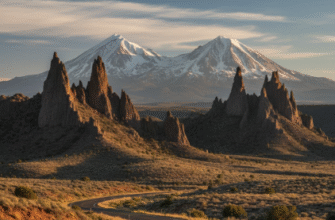
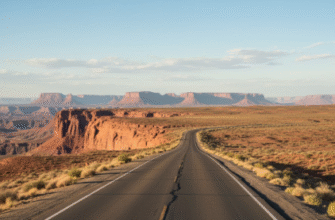
You’ll probably approach from either Cortez, Colorado (about 40 miles northeast) or from the Arizona side via Kayenta and Teec Nos Pos, and either way you’re looking at long stretches of high desert plateau where the sky takes up more space than seems physically possible and the earth is this deep red-brown that photographers love but that also makes you feel very small and very temporary. The road is well-maintained but empty in a way that roads rarely are anymore, and if you’re the kind of person who gets anxious in open spaces—I am, a little—you might find yourself driving faster than you planned, just to feel like you’re getting somewhere. There are no services for miles, so you gas up before you leave civilization, and you bring water, and you maybe question your choices a little when you’re an hour in and haven’t seen another car.
What the Monument Actually Tells You About Borders and the Strange Math of Statehood
Four Corners is the only place in the United States where four states meet at a single point, which is a fun trivia fact until you start thinking about why state borders are where they are in the first place—mostly arbitrary lines drawn by people in distant offices who’d never seen the land they were dividing, based on latitude and longitude rather than geography or the people who already lived there. The Navajo Nation, which covers parts of all three states (Utah doesn’t get much), predates these borders by centuries if you count the ancestral Puebloan presence, and the modern reservation boundaries were imposed in the 1860s after the Long Walk, a forced relocation that’s its own brutal chapter. Standing at Four Corners, you’re standing on land that’s been occupied for roughly 10,000 years, give or take, by people who didn’t recieve a say in where Colorado ended and New Mexico began. Anyway, the monument doesn’t really address this history in depth—there’s a small plaque, some context, but mostly it’s about the novelty of the four-state thing, which feels like a missed opportunity for deeper storytelling but also maybe that’s not what most visitors are here for.
The vendors, though—they’re worth your time and money if you’ve got both.