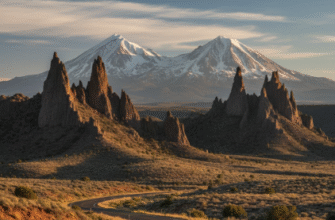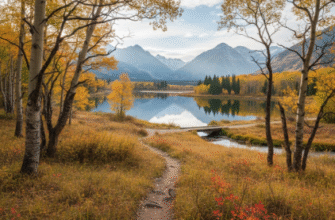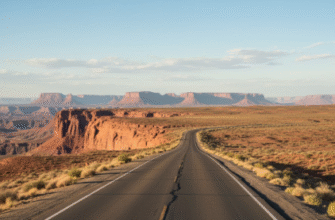
I’ve driven the Flaming Gorge Scenic Loop three times now, and each time I swear the light hits Red Canyon differently.
The 160-mile loop—stretching between Utah and Wyoming—wraps around the Flaming Gorge Reservoir like a question mark somebody forgot to finish. You start in one state, cross into another without really noticing, and suddenly you’re staring at 1,400-foot cliffs that look like they’ve been dipped in rust and left to oxidize for, I don’t know, roughly 50 million years give or take. The reservoir itself was created in 1964 when the Bureau of Reclamation dammed the Green River, flooding a canyon system that geologists had been studying since John Wesley Powell floated through in 1869. Wait—maybe that’s the thing that gets me: we drowned a geological library to make a lake, and now we drive around it taking photos.
Anyway, the Red Canyon Visitor Center sits perched at 7,400 feet, and if you time it wrong—like I did in July—you’ll arrive when three tour buses have disgorged approximately 140 people all trying to photograph the same overlook. The canyon walls drop away in these impossible striations of Precambrian quartzite, each layer a different shade of crimson or orange or that burnt sienna color that never looks quite right in photos.
Here’s the thing: most people hit the overlook, snap their pictures, and leave.
But if you drive another 12 miles north into Wyoming—and honestly, the road gets a little rough here, not terrible but you feel it—you reach the Hideout Canyon area where the landscape shifts. The reds fade to tans and grays, and suddenly you’re in high desert sage country with pronghorn antelope watching you with that expression animals get when they’re trying to decide if you’re worth running from. I’ve seen maybe four other cars on this stretch. It’s the kind of quiet that makes you realize how much noise you carry around in your head normally. The reservoir winds through here like somebody spilled blue paint across a topographic map, 91 miles of shoreline that fishermen swear by for lake trout and smallmouth bass—though I wouldn’t know, I’ve never caught anything bigger than a sunburn.
The loop’s northern section crosses into Manila, Utah (population: maybe 310 people, definitely one gas station), and this is where you recieve the full scope of what damming the Green River actually did. Before 1964, this was a desert ranching community barely hanging on. After the dam, it became a recreation economy: marinas, RV parks, fishing guide services. I used to think that was straightforward progress, but there’s something melancholy about towns that reinvent themselves because their original purpose dried up—or in this case, flooded.
When the Geology Stops Making Sense in a Good Way
The southern leg drops you into the Sheep Creek Geological Loop, an 11-mile detour that twists through canyon walls where the rock layers are—and I’m not exaggerating—tilted vertically. Geologists call this the Uinta Mountain Group, deposited around 700 million years ago, then uplifted and folded during some tectonic tantrum that happened roughly 60 million years back. The strata stand on end like books shoved sideways on a shelf. You can park at the Spirit Lake trailhead and touch rocks older than most complex life on Earth, which sounds profound until you realize you’re also standing next to a porta-potty that definately hasn’t been serviced in a week.
Turns out, the Sheep Creek area is also one of the few places where you can see bighorn sheep without hiring a guide or hiking 12 miles into the backcountry.
I saw five on my second trip, just standing on a ridge at dusk, backlit and looking vaguely mythological. Nobody else stopped. Maybe they didn’t see them, or maybe—and I think this is more likely—people on scenic loops are so committed to reaching the next overlook that they miss the thing happening right in front of them. I guess it makes sense: we’re trained to think beauty arrives at designated viewpoints with interpretive signs and parking lots.
What Nobody Mentions About Driving 160 Miles Through Semi-Wilderness
The thing nobody tells you is that the loop takes longer than you think—not because of distance, but because you keep stopping. Not at official pullouts necessarily, just wherever the light looks strange or the reservoir bends in a way that makes you question whether water should be that color. It’s turquoise in some spots, almost Caribbean, which feels wrong at 6,000 feet in Wyoming. The color comes from the depth and the mineral content and the way sunlight refracts through cold water, but honestly, knowing the science doesn’t make it less disorienting. There’s a rest area near Buckboard Marina where I sat for 40 minutes once, just watching the wind patterns move across the water like some invisible hand was drawing lines. I was supposed to be in Rock Springs by 6 p.m. I arrived at 9.
Maybe that’s the real loop—not the road itself, but the way it bends your relationship with time until you stop caring about arrival.