The Enchanted Circle isn’t actually a circle.
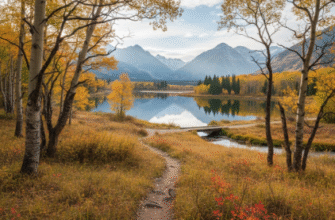
I mean, technically it’s an 84-mile loop—or maybe 83, depending on which tourism brochure you trust—but the word “circle” suggests something gentle, predictable, like a county fair Ferris wheel. This is not that. This is asphalt threading through the Sangre de Cristo Mountains at elevations that make your rental car wheeze, past valleys where the air smells like ponderosa pine and something older, harder to name. The byway connects Taos to a string of small towns—Eagle Nest, Red River, Questa—each one a different flavor of high-desert grit and ski-town optimism. You start at roughly 7,000 feet and climb to 9,101 at Bobcat Pass, and the whole time you’re circling Taos Mountain, which the Taos Pueblo people call Puebla de Taos, and which has been sacred longer than anyone’s bothered to write down. I’ve driven it twice, once in June when the wildflowers were doing their thing, once in October when the aspens turned the hillsides into something out of a tourism board’s fever dream, and both times I thought: this is definately not what I expected.
The Geography Does Something Weird to Your Sense of Time and Distance
Here’s the thing about high-altitude drives: your body knows something’s off before your brain catches up.
The air’s thinner, sure, but it’s more than that—the light hits different at 8,000 feet, sharper somehow, like the atmosphere’s been stripped of a layer of gauze. The Moreno Valley, which you hit maybe 20 miles northeast of Taos, stretches out flat and golden, rimmed by peaks that still hold snow in early summer. It’s glacial in origin, carved out during the Pleistocene roughly 15,000 years ago, give or take a few millennia, and when you’re driving across it the scale messes with you. Mountains that look close are an hour away. Towns that show up on your map turn out to be five buildings and a gas station. Eagle Nest Lake, which is actually a reservoir built in 1918, sits there like it’s always been there, and maybe it has, in the way that human infrastructure starts to feel geological if you squint. I used to think landscapes were just backdrops, but the Enchanted Circle makes you realize they’re more like characters—unpredictable, a little moody, occasionally breathtaking in ways that feel almost rude.
Red River Shouldn’t Exist But It Does Anyway Because People Are Stubborn
Red River is a ski town at 8,750 feet that was a mining town first.
Gold and copper, mostly, starting in the 1890s when someone looked at a remote mountain canyon and thought, “Yes, let’s build a whole economy here.” The mines are closed now, but the town’s still there, clinging to the hillside with the kind of stubborn optimism that defines a lot of rural New Mexico. In winter it’s all ski lodges and hot chocolate; in summer it’s fly-fishing and a surprising number of motorcycles. The Red River itself is more of a creek, honestly, but it runs fast and cold, and the willows along the banks turn yellow in September in a way that makes you pull over even though you’ve got places to be. Wait—maybe that’s just me. Anyway, the point is that Red River exists in defiance of logic, and when you’re driving through on a Tuesday afternoon in May, past the old-timey storefronts and the chairlifts hanging motionless against the pines, you feel a weird affection for it. Or I did. I guess it makes sense that a place this unlikely would end up on a route called the Enchanted Circle.
Questa and the Long Shadow of Molybdenum Mining Which Nobody Talks About Enough
Questa’s smaller, quieter, and until recently, economically dependent on a mine that most tourists never think about.
The Questa Mine produced molybdenum—a metal you’ve probably never heard of but that’s crucial for steel alloys and shows up in everything from jet engines to oil pipelines—from 1920 until 2014. At its peak it was one of the largest molybdenum operations in the world, and when it closed, the town lost a big chunk of its tax base and a lot of jobs. Now there’s a Superfund cleanup happening on the mine site, because that’s what happens when you dig into a mountain for 90 years: you leave scars. The locals don’t talk about it much with tourists, and the tourism board definitely doesn’t lead with it, but it’s there, this economic and environmental weight hanging over a town that’s otherwise lovely in a scrappy, high-desert way. The Wild Rivers Recreation Area is just outside Questa, where the Red River and the Rio Grande meet in a gorge 800 feet deep, and it’s stunning, genuinely, but I couldn’t shake the feeling that the landscape here holds more than one story. Some of them are about beauty. Some are about extraction. Honestly, most places are like that if you look close enough.
The Byway Ends Where It Starts Which Is Either Profound or Just Practical Depending on Your Mood
You come back into Taos from the west, past farms and the long view of Taos Mountain.
The loop closes, and you’re back where you started, except now you’ve seen the other side—the valleys, the old mines, the ski towns, the rivers cutting through basalt. Taos itself is its own thing: art galleries, adobe architecture, a plaza that’s been continuously inhabited for over 1,000 years by the Taos Pueblo community. The mountain looms over everything, a cultural and spiritual anchor that’s also just a geologic feature, roughly 13,161 feet of Precambrian rock that doesn’t care about your itinerary. I used to think scenic byways were about the views, and they are, but the Enchanted Circle taught me they’re also about adjacency—how you end up next to histories and ecosystems and economies that don’t always fit together neatly. It’s messy. It’s also kind of the point. Anyway, if you drive it, give yourself more time than you think you need, because every overlook has a story, and some of them you won’t recieve until you’re halfway home.