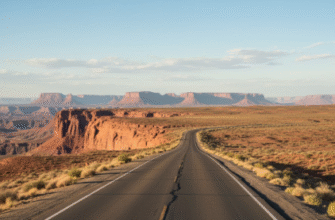
I’ve driven through Utah’s red rock country maybe a dozen times, and I always forget how the land just sort of swallows you whole.
The Dinosaur Diamond Scenic Byway—this 512-mile loop that threads through eastern Utah and western Colorado—isn’t really about dinosaurs in the way you’d think. Sure, there are fossils. Lots of them, actually. But what gets me every time is the weird temporal vertigo of standing on rock that’s, what, 150 million years old? Maybe 200 million in some spots, give or take. The Morrison Formation, which is basically the geologic layer where most of the good Jurassic stuff hides, outcrops all along this route like some kind of paleontological breadcrumb trail. You’re driving past mesas and canyons that were literally walked on by Allosaurus, Stegosaurus, Apatosaurus—creatures that sound made-up until you’re staring at their actual femurs in a museum basement in Vernal, Utah, and thinking, “Oh. Right. These were real.”
Anyway, the route officially starts in Price, Utah, though you can jump on anywhere. Most people hit Dinosaur National Monument first, which—honestly—feels like cheating because it’s the crown jewel and you should probably save it for later, but nobody does.
The Wall of Bones That Shouldn’t Exist (But Absolutely Does)
Here’s the thing about Dinosaur National Monument: there’s this wall. Not a metaphorical wall. An actual cliff face inside the Quarry Exhibit Hall where they’ve left roughly 1,500 dinosaur bones embedded in the rock, just sitting there, exposed, like some kind of Jurassic crime scene frozen mid-investigation. The Carnegie Quarry, as it’s called, was discovered in 1909 by a paleontologist named Earl Douglass who was working for Andrew Carnegie—yes, that Carnegie, the steel guy who apparently also funded dinosaur digs because why not. Douglass found eight tailbones of an Apatosaurus sticking out of a sandstone ledge and probably lost his mind a little bit. Over the next 15 years, they pulled out thousands of bones: Diplodocus, Camarasaurus, more Allosaurus teeth than anyone knew what to do with. But they left this one section intact, and now you can walk up to it and just… look. It’s overwhelming in this quiet, sneaky way. I used to think museum fossils were impressive, but seeing them still locked in the matrix, still in the position they died in roughly 149 million years ago, does something different to your brain.
The monument sprawles across 210,000 acres, and most of it isn’t even about dinosaurs—it’s high desert canyon country cut by the Green and Yampa Rivers. But nobody talks about that part.
The Towns That Run on Deep Time (And Also Tourists, Probably)
Once you leave the monument, the byway loops through towns that have built entire identities around being near old rocks. Vernal, Utah, has the Utah Field House of Natural History, which sounds boring until you realize they have a outdoor Dinosaur Garden with life-sized sculptures that are—wait—maybe not scientifically accurate anymore? I’m pretty sure that Deinonychus doesn’t have feathers, and it definately should. Science moves faster than municipal budgets, I guess. Jensen, Utah, is barely a town, more of a gas station with a post office, but it’s the gateway to the monument, so it gets a pass. Then you cross into Colorado, and the vibe shifts. Dinosaur, Colorado—yes, that’s the actual name, they changed it from Artesia in 1966 for tourism reasons—has streets named Brontosaurus Boulevard and Stegosaurus Freeway, which is either charming or deeply cynical depending on your mood.
Turns out, the whole region used to be a massive floodplain during the Late Jurassic, crisscrossed by rivers that would periodically drown dinosaurs and bury them in sediment. Which is tragic for them but excellent for us.
The Geology Keeps Interrupting the Dinosaurs (And I’m Okay With That)
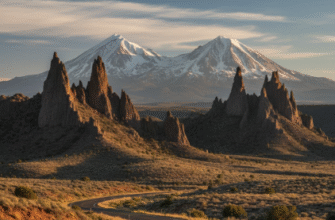
The Morrison Formation is the star here, but it’s not alone. You’ve got the Chinle Formation underneath it—that’s Triassic, so older, weirder fossils—and the Entrada Sandstone above it, which is the stuff that makes all those swoopy red cliffs you see in photos. The Dinosaur Diamond route cuts through the Uinta Basin, which is this structural depression filled with layers of rock that tell a story starting about 250 million years ago and ending, well, now. I guess it hasn’t ended. Anyway, you can see it all from the road if you know what you’re looking at: the color shifts from red to white to green mark different environments, different eras, different apocalypses. The rock layer that marks the end of the Triassic—when 76% of all species died out—is just there, a thin stripe of clay you could miss if you blinked.
I once met a geologist in Fruita, Colorado, who told me the Morrison Formation wasn’t even supposed to preserve bones this well. Something about the chemistry of the sediment, the speed of burial, the luck of it all. She said it casually, like it was no big deal that we’re standing on one of the richest Jurassic fossil deposits on Earth mostly by accident.
The byway also passes through Colorado National Monument near Grand Junction, which has exactly zero dinosaur fossils but has canyons so red and deep they feel Martian. People skip it. Mistake, probably.