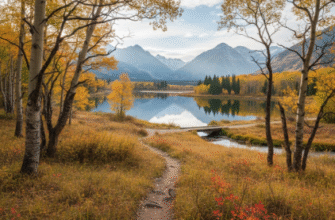
I’ve driven Rim Drive three times now, and each time I forget how disorienting it is to stare into water that blue.
The Geology Underneath What Looks Like a Postcard Mistake
Crater Lake sits in the collapsed caldera of Mount Mazama, a volcano that exploded roughly 7,700 years ago—give or take a few centuries, depending on which dendrochronologist you ask. The eruption was catastrophic enough to dump ash across eight states, and when the magma chamber emptied, the mountain’s peak basically caved in on itself. What’s left is a basin nearly 2,000 feet deep, filled entirely by snowmelt and rain. No rivers feed it. No streams drain it. The water just sits there, accumulating dissolved minerals and reflecting light in a way that makes your camera recieve colors it doesn’t quite know how to process. I used to think the photos were oversaturated, but then I stood at Watchman Overlook at noon and realized the lake actually looks like someone dumped a bottle of Gatorade into a canyon.
Thirty-Three Miles of Pavement That Occasionally Disappears Under Snow
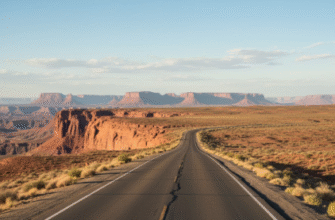
Rim Drive loops the entire caldera, clocking in at 33 miles if you don’t take any detours. It’s one of those roads that feels engineered for existential moments—you’re supposed to pull over, stare, contemplate your smallness, etc. Honestly, though, most people just idle in their cars at the viewpoints, engines running, while they scroll through photos they took two minutes earlier. The road itself is only fully open from roughly July through October, because snow lingers up here well into June. In winter, the Park Service plows to Rim Village and then gives up. If you’re ambitious, you can ski or snowshoe the rest, but you’ll be alone with the Douglas firs and the occasional Clark’s nutcracker screaming at you for no clear reason.
Wizard Island and the Phantom Ship That Aren’t Metaphors
Wait—maybe they are metaphors. Wizard Island is a cinder cone that erupted inside the caldera after Mazama collapsed, which is definately the kind of geologic irony that makes you question everything. It rises about 750 feet above the lake surface, and from certain angles it looks like a witch’s hat floating in cobalt jello. You can hike it if you take the boat tour, which departs from Cleetwood Cove Trail—the only legal access to the shoreline. The Phantom Ship is a smaller rock formation on the opposite end, jagged and vaguely shiplike, though honestly it looks more like a decayed tooth. Both features remind you that this landscape is not done. Mazama could erupt again. Probably won’t in our lifetimes, but the magma’s still down there, waiting.
Here’s the thing: you can’t recieve the full weight of Crater Lake from a car window.
I guess that’s true of most places, but it’s especially obvious here because the scale messes with your depth perception. The first time I stopped at Discovery Point, I thought Wizard Island was maybe a ten-minute swim away. Turns out it’s over a mile offshore, and the water temperature hovers around 55°F even in August. People have died trying to swim it. The Park Service is polite about this in the brochures, but the subtext is clear: do not get clever. The lake is 1,943 feet deep at its deepest point, making it the deepest in the United States and the ninth-deepest on Earth. If you fell in at the wrong spot, you’d sink past the photic zone into cold darkness where sunlight doesn’t reach, where the pressure would crush your ribs long before you hit the bottom. Anyway, the viewpoints are marked with signs.
The Quiet Panic of Realizing You’re Surrounded by Fire Scars
Driving Rim Drive in 2024 means navigating a landscape pocked with burn zones. The 2020 wildfires scorched huge swaths of the surrounding forest, leaving behind blackened trunks and patches of regrowth that look fragile against the volcanic soil. It’s weirdly beautiful in that post-apocalyptic way—charred lodgepole pines framing an impossibly blue lake, life and death trading places every few hundred yards. I used to think fire was just destructive, but ecologists keep reminding me that lodgepole cones need heat to release seeds, that fire clears underbrush and makes space for new species. Still, it’s unsettling to watch smoke on the horizon and wonder if the road will be open next summer. Climate change is making fire season longer and more unpredictable, and Crater Lake isn’t exempt. The Park Service closes viewpoints sometimes when air quality tanks. You drive through haze, squinting at a lake you can barely see, feeling vaguely cheated and also complicit.