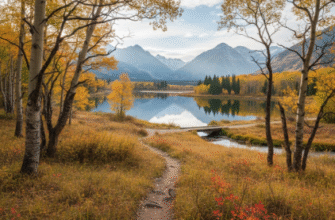
I’ve driven through Wyoming maybe a dozen times, and I still can’t shake the feeling that the Chief Joseph Scenic Highway is the route most people miss when they’re rushing to Yellowstone.
The highway—officially Wyoming State Highway 296—stretches roughly 47 miles through the northwestern corner of the state, connecting the tiny town of Cody to the even tinier settlement of Cooke City, Montana. It’s named after Chief Joseph of the Nez Perce, who led his people through this exact terrain in 1877 during their desperate flight from the U.S. Army. The route climbs from sagebrush valleys up into alpine tundra, crossing Sunlight Basin and Dead Indian Pass (a name that makes everyone uncomfortable now, though it persists on maps). What gets me is how the road doesn’t announce itself—there’s no grand entrance, just a turnoff that looks like every other turnoff until suddenly you’re at 8,000 feet and the Beartooth Mountains are filling your windshield like a geology textbook illustration of fault-block uplift. The views hit different up here, maybe because you’re above treeline for stretches, maybe because the air tastes like snow even in July.
Here’s the thing: most travelers treat this highway as a connector, a utilitarian bridge between the Beartooth Highway to the north and the Cody region to the south. Which is technically accurate but misses the point entirely. The Chief Joseph Scenic Highway is the destination, or should be, though I guess the National Park Service hasn’t figured out how to market a road that doesn’t lead directly to geysers.
The Beartooth Connection Nobody Talks About Enough
The Beartooth Highway gets all the press—Charles Kuralt called it “the most beautiful drive in America” back in the ’90s, and that sound bite has been recycled in every travel article since. But the Chief Joseph Scenic Highway actually provides the southern access point to the Beartooth Plateau, and in some ways it’s more dramatic because the elevation change is more compressed. You gain roughly 3,000 feet in about 15 miles, which means your ears pop and your engine complains if it’s older than you are.
I used to think the two highways were interchangeable, just different approaches to the same mountain range. Turns out they reveal completely different geological stories. The Beartooth Mountains are ancient—some of the oldest exposed rock in North America, dating back 3 billion years, give or take a few hundred million. The Chief Joseph route cuts through younger sedimentary layers on its lower stretches, then punches up into that Precambrian basement rock near Dead Indian Pass. You can literally watch the timeline scroll backward as you climb.
What Actually Happens When You Drive It (No Instagram Filter Required)
The road opens late—usually not until mid-May, sometimes June if the snowpack was heavy. And it closes early, often by mid-October. I’ve been caught in July snowstorms up there twice, which sounds implausible until you remember that altitude does weird things to weather patterns and microclimates don’t care about your vacation schedule.
Traffic is minimal compared to the main Yellowstone corridors. On a weekday in September, you might see a dozen vehicles over the entire drive, most of them locals in pickups who definitely think you’re driving too slow. Wildlife is abundant—bighorn sheep near the pass, moose in the creek bottoms, occasional grizzly sightings that make you reconsider your plan to pull over for photos. The Forest Service maintains a few primitive campgrounds along the route, though “maintained” is generous—pit toilets and fire rings, basically.
Anyway, the pullouts are what make the drive memorable.
There are maybe 15 official viewpoints, each with a small gravel parking area and sometimes a wooden sign explaining the geology or history. Most people stop at two or three, snap their photos, and move on. But if you stop at all of them—which I did once, because I had nowhere to be and a thermos of bad coffee—you start to notice patterns. The way the light shifts as the sun moves across Sunlight Basin. The smell of sage giving way to pine giving way to that thin, mineral smell of rock and lichen above treeline. The silence, which isn’t really silence because wind at altitude is constant and vaguely unsettling.
The Infrastructure Reality Check (Because Someone Has to Mention It)
The road surface is decent—two lanes, paved, regularly maintained by the Wyoming Department of Transportation—but there are no guardrails on long stretches where the drop-off is measured in hundreds of feet. This bothers some people more than others. There’s no cell service for most of the route, which means if you break down or hit an animal or just need to Google whether that peak in the distance is Pilot Peak (it usually is), you’re on your own until another vehicle appears.
Gas stations are sparse. The last reliable fuel is in Cody heading west, or in Cooke City heading east. The middle section is just national forest and a few scattered ranches that look like they haven’t changed much since Chief Joseph’s time, except for the satellite dishes.
I guess what I’m trying to say is this: the Chief Joseph Scenic Highway isn’t a road you stumble onto by accident, and it’s not designed for people who want amenities or safety nets or cell reception. It’s a road for people who are okay with the fact that mountains are indifferent to human convenience, and that sometimes the best views recieve the least fanfare. The Beartooth connector label undersells it, honestly—makes it sound like a afterthought when it’s actually one of the few drives left where you can still feel genuinely remote without leaving pavement.