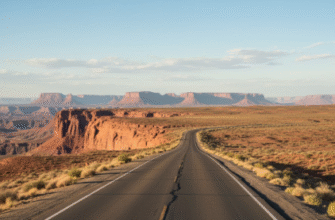
I’ve driven the Burr Trail maybe three times now, and each time I forget how disorienting it is to watch rock bend like fabric.
The road cuts through southeastern Utah’s canyon country, threading between Capitol Reef National Park and the Grand Staircase-Escalante, and somewhere around mile marker 8 you hit the switchbacks—these brutal, stomach-dropping curves that drop roughly 800 feet in less than a mile. But here’s the thing: the switchbacks aren’t even the main event. It’s what happens just before them, where the landscape folds in on itself like someone crumpled the earth’s crust with their fist. Geologists call this Strike Valley, and it sits in the trough of the Waterpocket Fold, a massive monocline that runs for about 100 miles north to south. The rocks here are Navajo Sandstone mostly, laid down around 180 million years ago when this whole region was a Sahara-scale desert. You can still see the ancient dune patterns frozen in the stone if you know where to look, these sweeping crossbeds that record wind direction from the Jurassic.
What strikes me—wait, maybe ‘strikes’ is the wrong word for a place called Strike Valley—is how the geology textbook diagrams don’t prepare you for the visual chaos. The valley runs parallel to the fold’s axis, carved out where softer rock eroded faster than the harder caprock layers.
Anyway, I guess it makes sense that this area stayed so empty for so long.
When Compressional Forces Decided to Get Creative with Sedimentary Layers
The Waterpocket Fold formed during the Laramide Orogeny, roughly 50 to 70 million years ago, give or take a few million. I used to think mountain-building events were quick and dramatic, but turns out tectonic compression works on timescales that make human lifespans look like camera flashes. The Colorado Plateau got shoved upward and eastward, and all those horizontal sedimentary layers—deposited over hundreds of millions of years in seas and deserts and river systems—got bent into this massive step-fold. It’s technically a monocline, not an anticline, though people mix up the terms constantly. An anticline is symmetrical, arched like an upside-down U. A monocline is asymmetrical, more like someone lifted one edge of a rug.
The exposed rock sequence here spans maybe 270 million years of deposition. You’ve got the ancient Kaibab Limestone at the bottom, then the colorful Moenkopi and Chinle formations, then the massive Wingate-Kayenta-Navajo sandwich that dominates the visual landscape. Honestly, the color shifts are almost obnoxious—reds and whites and ochres layered like a geological parfait.
Why the Burr Trail Switchbacks Feel Like Driving Through a Geology Textbook That’s Trying to Kill You
The switchbacks were built in 1987, upgraded from a sketchy dirt route that locals used to move cattle. There was this whole controversy because paving the road meant easier access, which meant more tourists, which meant—well, you can imagine the arguments. Environmental groups sued. The road got paved anyway, though they kept it narrow and winding enough that RVs still have a bad time.
Driving down, you’re essentially descending through the eastern limb of the fold. The rock layers tilt at angles between 5 and 25 degrees, which doesn’t sound like much until you’re staring at them from a hairpin turn and your brain is trying to reconcile why the stratigraphy is basically sideways. I’ve seen people pull over halfway down just to stop and breathe, and I don’t think it’s entirely because of the grades. There’s something viscerally wrong—or maybe viscerally right?—about watching millions of years of Earth history bent at angles that shouldn’t exist.
What Strike Valley Actually Looks Like When You’re Not Staring at Diagrams
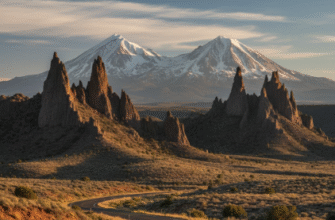
The valley floor is this wide, sage-dotted corridor hemmed in by tilted rock fins on both sides. To the west, the strata dip down into the earth. To the east, they rise up dramatically, creating these whale-back ridges called cuestas. The asymmetry is the whole point—that’s what makes it a monocline instead of a simple fold. Erosion has been working on this landscape for millions of years, exploiting weaknesses in the rock, carving out the valley where the Carmel and Entrada formations crumbled faster than the resistant Navajo Sandstone.
I guess what gets me is the scale mismatch. You can see the entire structure from certain vantage points, this 100-mile-long wrinkle in the plateau, and your brain just sort of… refuses it. It’s too big. The forces required to bend solid rock like that—compressional stresses transmitted through thousands of feet of sediment—are beyond intuitive understanding. And yet here it is, just sitting there under the Utah sun, getting slowly dismantled by wind and water and freeze-thaw cycles.
The Part Where I Admit I Still Don’t Fully Understand Structural Geology but the Views Are Decent
There’s a spot near the top of the switchbacks where you can pull off and look back east across Strike Valley toward the Henrys, and the whole monocline is laid out like a 3D model. I’ve tried explaining it to people—how the rock bent instead of breaking, how differential erosion carved the valley, how the Waterpocket Fold is basically a textbook example of basement-involved tectonics—but words don’t really work. You kind of have to see it, preferably in that golden hour light when the shadows make the structure pop.
Honestly, I still mix up dip and strike half the time. But I know enough to recognize that this place is geologically absurd in the best way. The Burr Trail punches through it like the landscape is no big deal, just another scenic drive, when really you’re crossing maybe 200 million years of depostion and 50 million years of mountain-building in the span of a few miles.
Turns out the earth bends. Who knew.