
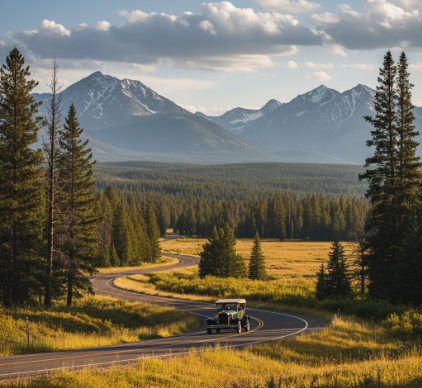
I’ve driven the Buffalo Bill Cody Scenic Byway maybe four times now, and honestly, each trip feels like the first.
The route—officially US Highway 14/16/20—stretches roughly 52 miles from Cody, Wyoming, straight to Yellowstone’s East Entrance, and here’s the thing: it’s not just a road, it’s a geological argument unfolding in real time. You start in the Absaroka Range foothills, where volcanic rock formations date back something like 50 million years, give or take, then climb through Shoshone National Forest (the oldest national forest in the U.S., established 1891, if we’re being precise). The North Fork of the Shoshone River runs parallel most of the way, carving through valleys that look like they’re still figuring out their final shape. Buffalo Bill himself pushed for this corridor in the early 1900s, lobbying for infrastructure that would connect his namesake town to the park—turns out he wasn’t just a showman, he was a pretty shrewd regional planner.
Wait—maybe I should mention the tunnels. There are five of them, blasted through solid rock in the 1930s by Civilian Conservation Corps crews, and they’re narrow enough that you instinctively hold your breath even though your car fits fine. The names are wonderfully dramatic: Elephant Head, Laughing Pig, all named after rock formations that supposedly resemble things if you squint hard enough.
When Geology Meets Hospitality Infrastructure (and Neither Wins Cleanly)
The byway passes the Buffalo Bill Reservoir, impounded by the Buffalo Bill Dam, which held the title of world’s tallest dam from 1910 to 1927 at 328 feet—though they raised it another 25 feet in the 1990s because, I guess, dams are never quite tall enough. The reservoir’s a strange turquoise color in summer, something about glacial sediment refracting light, and it definately catches you off guard if you’re expecting the muddy browns of most Western waterways. Pahaska Tepee, Buffalo Bill’s old hunting lodge built in 1904, still operates near the park entrance, log-hewn and stubbornly authentic in a way that modern replicas can’t quite manage. I used to think these roadside historical sites were just tourist traps, but Pahaska feels lived-in, like the logs still remember winters.
The elevation gain is roughly 4,000 feet from Cody (elevation 5,016 feet) to Sylvan Pass just inside Yellowstone (8,524 feet), and your ears pop twice before you notice.
Anyway, the wildlife situation is legitimately unpredictable—I’ve seen bighorn sheep on the roadside near Mummy Cave (an archaeological site with evidence of human habitation spanning 9,000 years, though good luck spotting it from the highway), and once a grizzly that seemed as annoyed by traffic as I was. The Forest Service posts bear activity warnings semi-regularly, which you should probably take seriously even if you’re just pulling over for photos. The thing about this route is it compresses ecosystems: you start in high desert scrub, transition through Douglas fir and lodgepole pine forests, then hit subalpine meadows that bloom with wildflowers in late June—lupine, Indian paintbrush, arnica—all crammed into an hour’s drive. It’s ecologically efficient, if nothing else.
Why the Last Twenty Miles Feel Like a Different Planet (Even Though They’re Technically Still Wyoming)
Sylvan Pass, the final climb before Yellowstone proper, closes periodically in winter for avalanche mitigation—sometimes into May—which tells you everything about the snowpack dynamics up there. The road narrows, the drop-offs get aggressive, and the trees thin out until you’re above treeline, surrounded by the kind of raw, unfinished landscape that makes you reconsider your faith in guardrails. Then you round a bend and Yellowstone Lake appears below, vast and implausibly blue, and the transition from byway to national park feels less like crossing a boundary and more like stepping through a curtain into a place that’s been waiting. I guess that’s what Buffalo Bill wanted all along—a threshold that felt like arrival.








