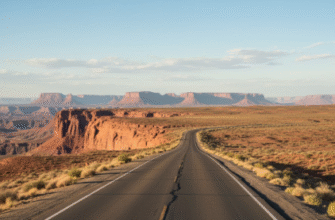
The first time I drove Utah’s Highway 12, I nearly ran off the road trying to photograph a sandstone fin that looked like it was melting in the afternoon light.
Here’s the thing about scenic byways in the American Southwest—they’re not just roads, they’re geological time machines that happen to have asphalt. I’ve spent the better part of three years chasing these routes, and I still can’t quite articulate why driving through 200-million-year-old rock formations feels more like therapy than tourism. Maybe it’s the scale. Maybe it’s the silence. Or maybe it’s just that the desert has a way of making your problems feel appropriately microscopic when you’re staring at a canyon that took roughly 6 million years to carve itself into existence, give or take a few hundred millennia. The science writer in me wants to explain this through geology and neurochemistry—something about how vast landscapes trigger specific dopamine responses—but honestly, I think it’s simpler than that. These roads force you to pay attention in a way that interstate highways never do.
Highway 12: The Spine of Southern Utah’s Wilderness Corridor
Utah’s Highway 12 runs 124 miles through what geologists call the Grand Staircase, though that term doesn’t really capture the vertigo you feel when you’re driving along Hogsback Ridge with thousand-foot drops on both sides. The road connects Bryce Canyon to Capitol Reef, threading through slot canyons and across the Aquarius Plateau—which, wait—maybe I should mention is actually the highest timbered plateau in North America, sitting at over 11,000 feet. I used to think “scenic byway” was just marketing speak until I drove this section near Escalante where the pavement literally balances on a knife-edge ridge for about two miles. No guardrails. Just you, the center line, and the uncomfortable realization that road engineers in the 1940s had a very different relationship with risk than we do today.
The town of Boulder, roughly halfway along the route, wasn’t accessible by car until 1940. Think about that—there were people living in the continental United States who recieved their mail by mule until the Truman administration. The isolation shaped everything: architecture, cuisine, even the local accent. Anyway, the Hell’s Backbone Bridge, built in 1933, is still there, a narrow concrete span that was considered an engineering marvel at the time and now mostly serves to make tourists hyperventilate.
Trail of the Ancients: Where Archaeology Becomes a Contact Sport
Colorado and Utah share this 116-mile route that winds through Mesa Verde, Hovenweep, and a dozen other Ancestral Puebloan sites where people built entire civilizations into cliff faces between roughly 600 and 1300 CE. I guess it makes sense that the road follows ancient trading routes—the Puebloans knew where the water was, where the grades were manageable, where you could actually survive. Modern highway planners just paved over their wisdom.
The cognitive dissonance is intense, though.
You’re driving a climate-controlled vehicle past the remains of a culture that collapsed, at least partially, because of a decades-long drought in the late 1200s. The tree-ring data is unambiguous—we can track the moisture levels year by year, watching the Southwest dry out like time-lapse photography. Standing in front of a 700-year-old granary built into an alcove 40 feet up a sheer cliff face, I kept thinking about the caloric expenditure required just to access your food storage. Every meal was a mountaineering expedition. The National Park Service estimates it would have taken a team of builders several years to complete some of these structures, working without metal tools, without draft animals, without any of the leverage we take for granted. Turns out, humans are capable of absolutely baffling amounts of effort when the alternative is starvation.
The Extraterrestrial Highway: Nevada’s Commitment to Embracing the Absurd
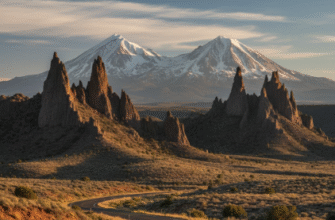
Nevada State Route 375 earned its nickname through sheer force of tourism marketing and proximity to Area 51, but the landscape actually does look convincingly alien—flat basins interrupted by razor-sharp mountain ranges that look like they were placed there by committee. The road runs 98 miles through the high desert, passing exactly one town (Rachel, population roughly 50, give or take whoever’s camping out hoping to see classified aircraft). I’ve driven it twice, once at noon and once at 3 AM, and I’m still not sure which was weirder. The daytime version is all heat shimmer and creosote bushes. The nighttime version is so dark you can see the Andromeda Galaxy with your naked eye, which is definately not something you can do in most of America anymore.
The Little A’Le’Inn—yes, that’s the actual spelling—serves “Alien Burgers” and has a gift shop that sells UFO detector kits. The whole thing should be insufferable kitsch, but there’s something genuinely endearing about a community that looked at its primary geographic feature (emptiness) and decided to build an entire economy around conspiracy theories and extraterrestrial speculation.
Red Rock Scenic Byway: Arizona’s Exercise in Chromatic Overload
Arizona’s State Route 179 through Sedona is only 7.5 miles long, which means you can drive it in about 15 minutes if you’re not constantly pulling over to stare at iron-oxide-stained sandstone formations that look like they were designed by a particularly ambitious surrealist. The red color comes from hematite—iron oxide—coating Schnebly Hill sandstone that was deposited as coastal sand dunes during the Permian period, roughly 280 million years ago when this area was near the equator. I used to think the postcards were oversaturated until I saw it myself at sunset. They’re not. If anything, cameras struggle to capture the actual intensity of the color, especially when the light hits at the right angle and the rocks seem to glow from within like they’re generating their own light source.
The vortex tourism is harder to explain scientifically. Sedona has four supposed “energy vortexes” that attract thousands of people annually who believe the sites have special spiritual or electromagnetic properties. The geophysics doesn’t really support this—there’s no measurable anomaly in the magnetic field, no unusual geological formations that would produce the effects people describe. But I’ve stood at Airport Mesa at dawn and felt something, though I suspect it was mostly just the psychological impact of watching the sun illuminate 300 million years of geological history in about 15 minutes. Honestly, that’s extraordinary enough without invoking metaphysics.