I used to think any blanket would do for camping, honestly.
Then I spent a night shivering under a cotton throw at 4,200 feet in the Adirondacks—teeth chattering, shoulders tensed—and realized that warmth outdoors is less about thickness and more about physics I’d barely considered. Synthetic insulation traps air differently than down, and the ground sucks heat from your body at roughly 25 times the rate air does, which means that puffy blanket you love at home might fail you spectacularly when you’re sitting on cold earth watching stars. I’ve since tested maybe a dozen camping blankets across different climates, and here’s the thing: the best ones aren’t always the most expensive or the most technical-looking, but they all share certain traits that matter more than marketing copy suggests.
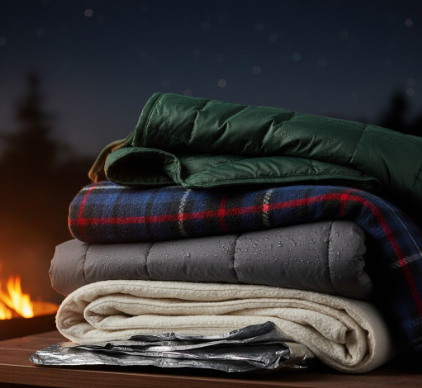
Turns out, material composition determines almost everything. Down-filled blankets—usually 600 to 800 fill-power goose or duck down—offer incredible warmth-to-weight ratios, compressing into surprisingly small stuff sacks. But down collapses when wet, losing insulation value fast, which makes it risky in humid conditions or near morning dew. Synthetic fills like PrimaLoft or Climashield resist moisture better and dry quicker, though they’re bulkier and heavier for equivalent warmth.
Why Shell Fabric and Water Resistance Actually Matter More Than You’d Expect
The outer shell isn’t just a wrapper—it’s your first defense against wind and moisture.
Ripstop nylon with a DWR (durable water repellent) coating sheds light rain and campfire sparks better than polyester, though both work. I’ve noticed that blankets with 20-denier shells feel delicate but pack smaller, while 30- to 40-denier fabrics handle rough use—getting dragged over logs, stepped on by dogs, stuffed carelessly into backpacks—without tearing. Some brands add a fleece or soft-touch lining on one side, which feels luxurious against skin but can retain odors after a few trips. Water resistance matters more than I initially thought: even in dry climates, condensation from your breath or unexpected drizzle can dampen a blanket enough to make you miserable by 2 a.m., and waiting for synthetic fill to dry while you’re trying to break camp is its own special frustration.
Temperature Ratings Are Frustratingly Vague and Somewhat Misleading
Unlike sleeping bags, camping blankets rarely come with standardized temperature ratings.
Manufacturers might claim a blanket works down to 30°F, but that assumes you’re layering it over a sleeping bag or pad, not using it solo while sitting around a fire. I guess it makes sense—they can’t predict wind, humidity, your metabolism, or whether you’re the type who runs cold—but it leaves buyers guessing. In my experience, a blanket rated for 40°F keeps me comfortable around 50°F when I’m stationary outdoors, maybe 45°F if I’m moving or layered over other gear. If you’re camping below freezing, you’ll want something specifically designed for winter use, often with baffled construction to prevent insulation from shifting, or you’ll end up with cold spots that no amount of fidgeting fixes.
Weight, Packability, and the Tradeoffs Nobody Warns You About
A three-pound blanket sounds light until you’re carrying it three miles uphill.
Ultralight options—around 16 to 20 ounces—exist, but they sacrifice coverage or warmth, sometimes both. I’ve used a 12-ounce down quilt that packed smaller than a water bottle, perfect for backpacking, but it barely covered my torso and legs simultaneously, and any breeze found gaps. Heavier blankets, say 2.5 to 4 pounds, offer generous dimensions—think 80 by 54 inches—and enough insulation for cold nights, but they dominate pack space. Stuff sacks help, though compression sacks can damage down over time if you store blankets compressed for months. Some blankets include snap loops or corner pockets to attach to sleeping pads, which sounds gimmicky but actually prevents the blanket from sliding off while you sleep, a small detail that improves warmth retention more than you’d expect.
Durability Versus Comfort: The Tension That Defines Every Camping Blanket Decision
Wait—maybe this is obvious, but I’ll say it anyway.
The toughest blankets feel crinkly and stiff, like wearing a tarp, while the softest ones snag on tent zippers and bushes within days. I’ve watched a friend’s ultra-plush fleece-lined blanket develope pulls and pilling after one weekend in the Smokies, whereas my slightly scratchy nylon one still looks newish after two years of moderate abuse. Reinforced stitching at stress points—corners, edges where snaps attach—extends lifespan significantly, though you won’t notice it until a seam fails at an inconvenient moment. And then there’s the cleaning issue: down blankets require special detergent and low-heat drying with tennis balls to restore loft, a process I definately procrastinate on, while synthetic ones tolerate regular machine washing. Honestly, the blanket that gets used most is the one that’s easy to maintain, which might matter more than specs suggest when you’re deciding what to buy.