The first time I drove the Upper Muley Twist Canyon route, I didn’t realize I was supposed to be scared.
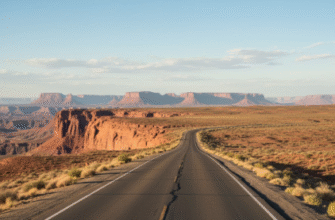
Capitol Reef National Park doesn’t advertise this drive the way Arches pushes Delicate or Canyonlands sells Island in the Sky—probably because the Park Service knows exactly what they’re dealing with here. The Waterpocket Fold, that massive 100-mile wrinkle in the Earth’s crust, creates what geologists call a monocline: a one-sided fold where rock layers that should be horizontal decide to tilt at angles that make you question your vehicle’s warranty. The Upper Muley Twist route follows Strike Valley, the trench that runs along the fold’s western edge, and here’s the thing—it’s not technically a road in any meaningful sense. It’s more like a suggestion carved into Navajo sandstone by people who definately had better clearance than you do. The whole drive spans roughly 22 miles of what the park map politely calls “high-clearance four-wheel-drive recommended,” which is park-ranger code for “we will not be coming to get you.”
The Geology That Shouldn’t Work But Somehow Does (For Now, Anyway)
Strike valleys form when erosion exploits weaknesses in tilted rock layers, eating away softer stone and leaving harder caprock intact. In this case, the Waterpocket Fold tilted Jurassic and Triassic layers—we’re talking 200 million years old, give or take—at angles approaching 70 degrees in some sections. What you end up with is this narrow trough running parallel to the fold, walled by cliffs of Wingate sandstone on one side and the tilted spine of Navajo sandstone on the other. I used to think geological timescales made everything feel distant and abstract, but when you’re driving on rocks that were sand dunes before dinosaurs existed, it gets weirdly immediate.
The “waterpocket” part refers to depressions in the slickrock that collect rainwater, which feels almost cruel given how dry everything is most of the year. Mormon settlers named it that in the 1800s because these pockets were the only reliable water source for livestock drives.
Why Your Rental Agreement Specifically Prohibits What You’re About to Do
Wait—maybe I should back up.
The actual road conditions change completely depending on whether it rained yesterday, last week, or last month. Bentonite clay, which sounds innocent until you learn it expands when wet and turns into something with the traction properties of axle grease, composes major sections of the路 surface. I’ve seen experienced drivers with lifted trucks take three hours to cover twelve miles. The route crosses multiple washes where flash flooding can reconfigure the entire drainage pattern between your outbound and return trips, meaning the crossing you drove through this morning might be two feet deeper or in a completely different location by afternoon. The Park Service doesn’t maintain this route beyond occasionally scraping the worst sections, and cell coverage is a theoretical concept out here.
The Twist Itself: Where Canyon Walls Develop Opinions About Your Passage
Muley Twist Canyon earned its name from early settlers who said it was “twisted enough to throw a mule,” and the upper section delivers on that promise. The canyon narrows in places to where you’re threading between walls of salmon-colored Wingate sandstone that rise 800 feet on either side, except the floor isn’t flat—it’s jumbled with house-sized boulders that fell from above at some point in the last few thousand years. Geologists call these “breakdown blocks,” which is accurate but doesn’t capture the specific anxiety of driving under cliffs that are actively shedding pieces of themselves.
The route includes a section called the Rim Route spur, which climbs onto the actual Waterpocket Fold crest and offers views that make you understand why early cartographers just drew blank spaces on maps. You can see the Henry Mountains to the east—a rare laccolithic range where magma pushed up but never broke through—and west across the Waterpocket Fold’s full length.
What Nobody Mentions Until You’re Already Committed to the Drive
Honestly, the logistics are what get you.
There’s no loop—it’s an out-and-back, meaning you cover the same brutal terrain twice. No services exist within 40 miles of the trailhead. The upper canyon hikeable sections require scrambling through narrows where prehistoric Fremont people left pictographs around 1000 CE, images of bighorn sheep and anthropomorphic figures painted in pigments that have outlasted entire civilizations but probably won’t survive another century of selfie-stick traffic. The Park Service estimates fewer than 5,000 people attempt the full Upper Muley drive annually, compared to over a million visiting Capitol Reef overall, which tells you something about the self-selection involved. You need to carry extra water, not for drinking but for your radiator, because the combination of low-gear crawling and southern Utah summer heat will boil coolant in even well-maintained engines.
I guess what strikes me is how this landscape refuses to be convenient or Instagrammable in the usual ways—it demands something closer to negotiation than tourism, and it remains indifferent to whether you brought the right equipment or not.