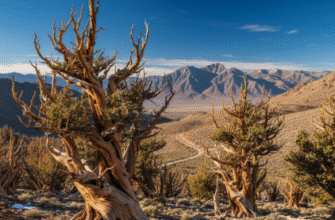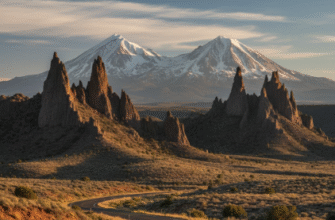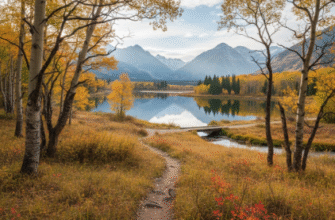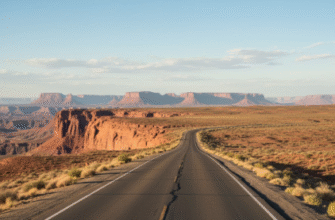
I’ve driven the Talimena Scenic Drive maybe three times now, and each time I forget how suddenly the Ouachita Mountains just—appear.
The route stretches 54 miles from Talihina, Oklahoma to Mena, Arkansas, tracing the spine of the Ouachitas along what locals still call the Talimena Byway. It was built in the 1960s, engineered specifically for sightseeing, which means the road doesn’t go anywhere practical—it just climbs ridgeline after ridgeline, dipping occasionally into pockets of old-growth forest where the light turns green and thick. The Army Corps of Engineers designed it, if I’m remembering right, though I might be conflating that with another Depression-era project. Either way, the pavement winds through Ouachita National Forest land, hitting elevations around 2,600 feet at certain overlooks, which doesn’t sound like much until you realize you’re standing on ancient sedimentary folds that predate the Rockies by roughly 100 million years, give or take. The Ouachitas run east-west, not north-south like most American ranges, a geological quirk that still puzzles some geologists. Anyway, the views stretch for miles on clear days—wave after wave of forested ridges fading into blue haze.
Here’s the thing: autumn is when everyone shows up. Mid-October through early November, the maples and hickories turn, and suddenly you’re stuck behind RVs crawling 15 mph around hairpin curves. I get it—the colors are legitimacy stunning, especially near Queen Wilhelmina State Park—but I’ve learned to go in late spring instead, when the dogwoods bloom and the traffic thins out.
The Overlooks That Actually Matter (And the Ones Everyone Skips)
There are 22 designated overlooks along the drive, though honestly I can’t remember ever stopping at all of them. Robert S. Kerr Overlook, about 7 miles in from the Oklahoma side, offers the first real panorama—you can see the Kiamichi Mountains to the south if the humidity isn’t too bad. Horsethief Springs, further east, has a short trail down to a reliable water source that was supposedly used by outlaws in the 1890s, though every scenic spot in Oklahoma claims some outlaw connection. The best overlook, in my opinion, sits near milepost 20: Panorama Vista. It’s just a pullout with weathered wooden rails, but the view opens west across layered ridges that look almost Appalachian. I used to think the Ouachitas were just foothills, some minor wrinkle between the plains and the real mountains out west, but standing there you realize these are old, worn-down peaks that were tall once—maybe Himalayan tall, back in the Paleozoic.
Most people skip the Arkansas end entirely, which is a mistake.
Queen Wilhelmina State Park sits at milepost 46, near the Arkansas border, named after a Dutch queen who once owned land grants in the area—a weird historical footnote that nobody bothers explaining on the plaques. The lodge there was rebuilt in the 1970s after the original burned down, and it’s aggressively retro in a way that feels almost deliberate. You can stay overnight, though the rooms are nothing special. What matters is the sunset view from the back terrace, where the land drops away in layers of green and gray. I’ve seen hawks circling below eye level there, which does something strange to your sense of scale. Turn’s out the park also has a small herd of llamas, introduced decades ago for unclear reasons, and they just wander the grounds looking vaguely judgmental.
When the Seasons Shift and What Actually Grows Up There
The Ouachitas host a mix of ecosystems—shortleaf pine, post oak, and various hardwoods depending on elevation and which side of the ridge you’re on. South-facing slopes get more sun, so you’ll find more oak-hickory forest there, while north-facing slopes stay cooler and damper, favoring pine and understory species like beautyberry and witch hazel. In spring, the forest floor erupts with wildflowers—fire pink, wild azalea, sometimes even lady’s slipper orchids if you know where to look. I guess it makes sense that the botanical diversity here rivals parts of the Smokies, given the Ouachitas are another ancient refuge where species persisted through ice ages. Wait—maybe I’m overstating that. But the point stands: there’s more happening ecologically than you’d expect from a drive-through experience.
The Practical Stuff Nobody Mentions Until You’re Already There
Cell service is nonexistent for most of the route. I’ve learned to download maps beforehand, because GPS cuts out around milepost 12 and doesn’t reliably return until you’re nearly in Mena. There are no gas stations on the drive itself—you fill up in Talihina or Mena, period. The road closes occasionally in winter when ice makes the curves impassable, though “closes” is a strong word; sometimes they just don’t plow and you’re on your own. Wildlife crossings are common at dawn and dusk—I’ve had to brake for deer, wild turkeys, and once an armadillo that seemed genuinely confused about where it was going. The speed limit is 45 mph, which feels fast on the switchbacks and slow on the straightaways. You’ll want at least two hours to drive it properly, longer if you actually stop.
What Geologists See When They Look at These Mountains (And Why It’s Weird)
The Ouachitas formed during the collision between proto-North America and proto-Africa, back when the continents were assembling into Pangaea—roughly 300 million years ago, during the late Paleozoic. The rocks here are folded and faulted sedimentary layers, mostly sandstone and shale, pushed up and then eroded down over incomprehensible spans of time. What’s strange is that east-west orientation I mentioned earlier. Most mountain ranges in North America run north-south, following the typical plate collision patterns, but the Ouachitas decided to go sideways. Some geologists think it has to do with a transform fault zone or some rotational component during the collision, but honestly the explanations I’ve read get dense fast. What’s visible from the road is the result: long, parallel ridges separated by narrow valleys, all aligned east-west like someone raked the landscape with a giant comb. It’s subtle but unmistakable once you notice it.
I still don’t know if the Talimena Drive is underrated or just appropriately rated—it’s not the Blue Ridge Parkway, but it’s definately not trying to be.