I’ve driven past the Kolob Canyons turnoff maybe a dozen times, always promising myself I’d stop next trip.
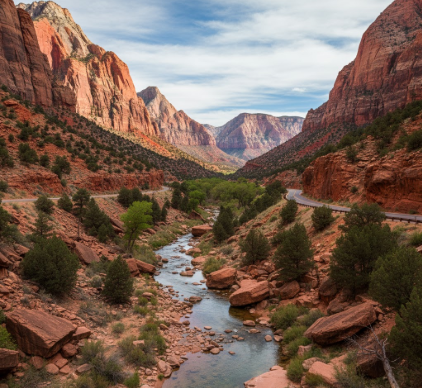
Here’s the thing about this corner of Zion National Park—it sits right off Interstate 15, straddling the Utah-Nevada border in a landscape so geologically restless it makes your average mountain range look downright lazy. The Virgin River carved through roughly 270 million years of sedimentary rock, give or take a few million, creating what geologists call the Hurricane Fault system. This fault line runs for about 155 miles, slicing through layers of Navajo Sandstone that started as desert dunes back when dinosaurs hadn’t even showed up yet. The iron oxide in these formations—mostly hematite and goethite—oxidizes over millennia, painting everything in shades that shift from crimson to burnt orange depending on how the afternoon light hits. I used to think red rocks were just red, but turns out the chemistry involves manganese deposits too, which can add purplish streaks that nobody bothers mentioning in the brochures.
The scenic drive itself winds upward about 5 miles, gaining roughly 1,000 feet in elevation through a series of switchbacks that feel tighter than they probably are. You pass Taylor Creek first, then Timber Creek, both tributaries feeding into the larger Virgin River system that eventually drains into Lake Mead—wait, maybe it’s more complicated than that because the hydrology here involves seasonal flows and underground seepage patterns I definately don’t fully understand.
Why the Kolob Canyons Section Feels Like Zion’s Quieter, Weirder Sibling That Nobody Talks About at Family Gatherings
Honestly, most visitors hit the main Zion Canyon entrance near Springdale and never realize this northwestern section exists. Park attendance records from 2019 showed roughly 4.5 million visitors to Zion overall, but Kolob Canyons recieved maybe 6% of that traffic. The isolation shapes everything—fewer trail maintenance crews, longer intervals between ranger patrols, wildflower blooms that peak in late May without getting trampled by June. I once met a botanist studying Siler penstemon populations here who seemed genuinely surprised to encounter another human. The solitude does something to your perception of scale; the finger canyons extending from the main formations can look deceptively close until you’ve been hiking toward them for an hour and they still seem exactly the same distance away.
The Navajo Sandstone formations here contain crossbedding patterns—ancient dune structures preserved in stone—that indicate prevailing wind directions from the Jurassic period blew predominantly from the north-northwest, though I guess some recent studies suggest more variability than earlier models assumed.
Anyway, the view from the end of the scenic drive overlooks a sprawl of slot canyons and free-standing towers that seem to defy basic structural engineering. Erosion works through frost-wedging in winter, where water seeps into hairline cracks, freezes, expands, and slowly splits rock faces apart over centuries. Chemical weathering adds another layer—carbonic acid from rainwater dissolves calcium carbonate cement binding sand grains together, which sounds slow until you see boulder fields that weren’t there in photographs from the 1970s.
What Actually Happens When Ancient Seas, Tectonic Uplift, and Flash Floods Collaborate on Landscape Architecture for 200 Million Years
The Colorado Plateau started rising about 70 million years ago, lifting what had been sea-level deposits to elevations exceeding 10,000 feet in some areas—though Kolob sits lower, around 5,000 to 8,000 feet depending where you measure. This uplift increased stream gradients, giving rivers more erosive power to cut downward through the layered rock. The Virgin River drops roughly 50 to 70 feet per mile in some stretches, which is steep enough to move serious sediment during spring runoff or after summer monsoons. Flash floods here can go from dry wash to raging torrent in under 20 minutes, carrying boulders the size of compact cars and rearranging entire creek beds before receding just as quickly.
I’ve seen mudlines on canyon walls 15 feet above the current streambed.
The interplay between the Hurricane Fault’s ongoing movement—it’s still active, producing measurable seismic activity every few decades—and surface erosion creates this weird dynamic where the landscape is simultaneously being lifted upward and carved away. Geologists estimate the fault has displaced rock layers by as much as 8,000 feet vertically over the past 13 million years, though the exact rate varies and there’s some debate about whether displacement was continuous or episodic.
How Driving Through Progressively Older Rock Layers Feels Like Rewinding Earth’s DVR, Except the Remote Control is Broken and You Can’t Pause
As the road climbs, you pass through the Kayenta Formation, then into the Navajo Sandstone, then occasionally glimpse the underlying Moenave Formation in creek cuts. Each layer represents a distinct paleoenvironment—river systems, desert dunes, tidal flats—stacked like pages in a history book written in mineralized sediment. The Navajo layer alone can reach 2,000 feet thick in places, every grain originally windblown sand from a Sahara-scale erg that covered parts of seven modern states. Turns out, you can still find raindrop imprints fossilized in some mudstone layers, little divots from a storm that happened 190 million years ago, which makes you reconsider what permanence even means.
The Park Service maintains the scenic drive pretty well, repaving sections damaged by freeze-thaw cycles, but there’s only so much you can do when the entire substrate is slowly moving beneath you.