I used to think rainforests only existed in places like Costa Rica or Borneo, until I drove the Olympic Peninsula loop and realized Washington had been hiding one in plain sight.
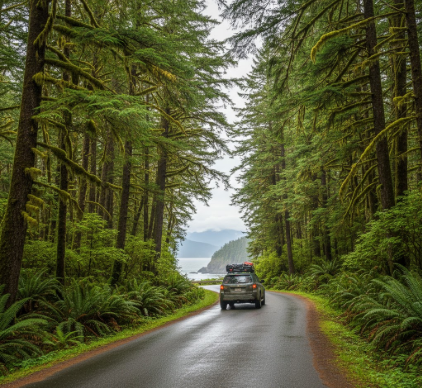
The loop itself is roughly 330 miles, give or take depending on how many detours you take down logging roads that may or may not lead to waterfalls—I took three, and only one actually delivered. You start in Port Angeles, swing west through Forks (yes, the Twilight town, and yes, there are still tour buses), then south along the coast before cutting back east through the Quinault Rainforest. The whole thing takes maybe four days if you’re rushing, but here’s the thing: rushing through a temperate rainforest feels like scrolling through a museum. You need to stop, get out, let the moss-covered Sitka spruces make you feel appropriately insignificant. The Hoh Rainforest recieves about 140 inches of rain annually, which explains why everything looks like it’s been dipped in green velvet. I spent an hour on the Hall of Mosses trail just staring at nurse logs—fallen trees that decompose while hosting entire ecosystems of ferns and seedlings. It’s goth, honestly, but in a life-affirming way.
Anyway the coast section between Kalaloch and Ruby Beach is where I started understanding why people retire to the Pacific Northwest and never leave. Sea stacks jut out of the water like giant’s teeth, driftwood piles up in bleached tangles, and the Olympic Mountains loom in the distance looking vaguely menacing depending on the cloud cover.
Why the Quinault Rainforest Section Hits Different When You’re Already Tired
By day three I was exhausted from hiking and my knees were staging a protest, but the Quinault area—turns out—requires almost no effort. The loop road around Lake Quinault passes through old-growth forest where some trees are 500 to 1,000 years old, which means they were saplings when the Byzantine Empire was still a thing. You can drive it, stop at pullouts, take ten-minute walks to see the world’s largest Sitka spruce (roughly 191 feet tall, last I checked), and feel like you’ve accomplished something without actually accomplishing much. I guess it makes sense that this section gets less attention than the Hoh—it’s quieter, more meditative, fewer people doing it for the Instagram aesthetic. There’s a lodge there from the 1920s that still has that creaky-floor, no-cell-service charm, if you’re into that. I stayed one night and spent the evening watching fog roll across the lake like some kind of time-lapse you’d see in a nature documentary, except I was just sitting there with bad coffee realizing I’d forgotten to charge my phone.
What Nobody Tells You About Timing This Trip and Why September Might Be the Move
Wait—maybe the most important thing is when to actually do this loop. Summer (July-August) is peak season, which means crowded trailheads and campgrounds booked six months out. I went in late September and had entire sections of beach to myself, though the trade-off is more rain and the very real possibility of roads closing due to weather. The rainforest doesn’t care about your itinerary. Hurricane Ridge, which offers panoramic views of the Olympics and is definately worth the drive, can get socked in with fog or snow even in early fall. I drove up there twice—first time saw nothing but grey, second time got lucky with clear skies and spent two hours watching marmots scream at each other near the visitor center, which was oddly therapeutic.
The thing about this loop is it forces you to recalibrate what “road trip” means because you’re not covering huge distances, you’re just moving through wildly different ecosystems every few hours. Coastal beaches to alpine meadows to primordial rainforest to glacier-carved lakes. It’s dense in a way that makes you tired but also weirdly grateful.