I used to think mountain loops were just for tourists with too much time and too little sense.
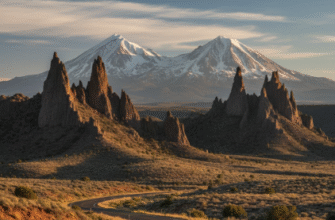
Then I drove the La Sal Mountain Loop—officially the La Sal Alpine Loop Scenic Byway, though nobody calls it that—and realized I’d been wrong about pretty much everything. This 63-mile ribbon of asphalt (give or take, depending on which trailhead detours you take) winds through the Manti-La Sal National Forest in southeastern Utah, climbing from the red-rock desert floor near Moab up to roughly 8,000 feet, sometimes higher, before dropping back down. The La Sals are laccolithic mountains, meaning they formed when magma pushed up between sedimentary layers but never actually broke through to the surface, creating these weird, bulging dome peaks that rise like geological blisters above the Colorado Plateau. They’re the second-highest range in Utah, topping out at Mount Peale’s 12,721 feet, and they collect enough snow to stay white-capped well into June, which is deeply strange when you’re staring at them from the scorching desert below. Anyway, the loop doesn’t summit Peale—you’d need to hike for that—but it gets you close enough to feel the temperature drop twenty degrees in twenty minutes, which is honestly disorienting in the best way.
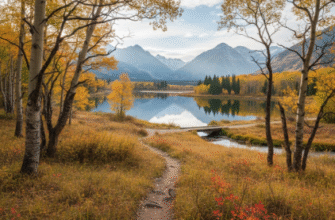
The aspen groves hit different up here, especially in late September when the leaves turn that specific shade of gold that makes you pull over even though you’ve already stopped three times. I’ve seen aspen forests in Colorado, and they’re fine, but something about the contrast here—the way the white bark and yellow leaves glow against dark spruce and that impossible red sandstone in the distance—it just works. Turns out the aspens are all clones, connected by massive root systems, some of which might be tens of thousands of years old, though the individual trunks only live maybe 80 years or so.
When the Pavement Ends and the Anxiety Begins (But in a Good Way, Mostly)
Here’s the thing: parts of this loop are paved, smooth, easy. Other parts are decidedly not. The western approach from Highway 191 is gentle, almost boring, winding through ranchland and scrub oak. But once you pass Warner Lake—a small, reedy thing that’s prettier than it sounds—the road starts to narrow and climb in earnest. Some sections are graded dirt, washboarded in places, and if you’re in a sedan with low clearance, you’ll spend a lot of time wondering if you’ve made a terrible mistake. I guess it depends on recent weather; spring runoff and summer thunderstorms can turn sections into rutted mud traps. The Forest Service maintains it, sort of, but maintenance out here means something different than it does in, say, a city park.
Wait—maybe that’s part of the appeal? The uncertainty? You’re driving through high-altitude meadows dotted with wildflowers (lupine, paintbrush, columbine if you’re lucky), and the road just… continues, threading between stands of ponderosa pine and fir, past old logging roads that vanish into the trees. Cell service is a joke. You might see another car every half hour, or you might not see one for three hours.
The Geology Doesn’t Care About Your Itinerary
The La Sals are roughly 28 million years old, formed during the Oligocene when a bunch of magma intrusions decided to push up through layers of Mesozoic sedimentary rock—sandstones and shales laid down when this whole area was underwater, back when Utah had oceans and dinosaurs and a climate that made sense. The laccoliths cooled slowly underground, which gave them time to crystallize into diorite porphyry, a rock that sounds made-up but isn’t. Erosion eventually stripped away the overlying sediment, exposing these mountains, and now they sit there like geological refugees, surrounded by desert that has no business being this close to alpine tundra. Honestly, it’s weird. The elevation gain creates these stacked life zones—you start in pinyon-juniper scrubland, pass through oak and aspen, climb into spruce-fir, and if you hike high enough, you hit tundra. All in the space of a few miles.
The Thing Nobody Mentions About Alpine Drives (Until You’re Already There)
You will definately need to pee, and there are no bathrooms. Not real ones, anyway. There are a few vault toilets at campgrounds—Warner, Oowah, Medicine—but they’re spaced far apart, and if you’re between them, well, you’re improvising behind a tree like a pioneer. Also, the weather is fickle in a way that feels almost personal. I’ve started a loop in 85-degree sunshine and finished in a hailstorm that left drifts of ice pellets across the road. The National Weather Service doesn’t really track conditions up here with much precision, so you’re gambling. Lightning is a real concern in summer afternoons; those exposed ridges and isolated trees are not where you want to be when thunderheads roll in, which they do, suddenly, with almost no warning except maybe a weird static feeling in the air that you should probably trust.
But then you round a curve and the whole Moab valley spreads out below, red and vast and silent, and you forgive everything. I guess it makes sense that this loop isn’t more famous—it’s too rough for tour buses, too slow for road-trippers in a hurry, too unpredictable for people who need guarantees. Which means it stays quiet, mostly, populated by locals who know the road’s moods and travelers who stumbled onto it by accident and couldn’t quite beleive what they found.