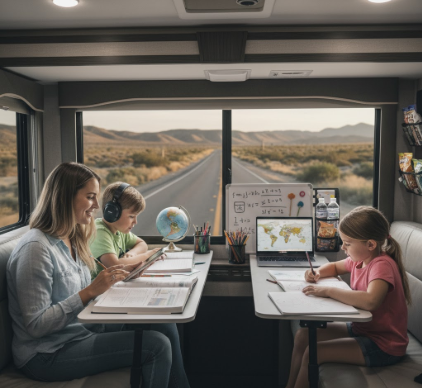
I used to think homeschooling on the road was some kind of Pinterest fantasy—laptops balanced on picnic tables, kids eagerly discussing photosynthesis while Mount Rushmore looms in the background.
Here’s the thing: it’s messier than that, and honestly, that’s fine. The first time I tried teaching fractions while my daughter was carsick somewhere outside Albuquerque, I realized the traditional classroom model doesn’t translate neatly to 70 mph. You’re dealing with limited space, inconsistent wifi, and the fact that your kid would rather watch the landscape blur past than conjugate verbs. Research from the National Home Education Research Institute suggests homeschooled students score roughly 15-30 percentile points above public school students on standardized tests, but they don’t mention how many of those families were simultaneously navigating rest stop bathrooms and arguing about whether audiobooks count as literature. The road changes everything—your curriculum needs to bend, not break.
Wait—maybe the car itself becomes the classroom, in a way that feels less forced. I’ve seen families use travel time for history lessons that actually make sense: discussing the Civil War while driving through Gettysburg, or talking about geology when you’re literally staring at sedimentary layers in the Grand Canyon. It’s opportunistic education, and it works better than you’d expect.
Converting Your Vehicle Into a Mobile Learning Environment Without Losing Your Mind
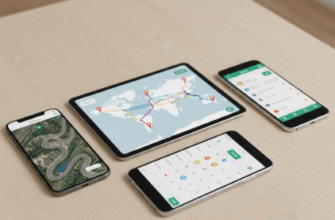
The backseat setup matters more than I initially thought it would. You need organizational systems that can survive sudden braking and the inevitable spilled juice box. Hanging organizers, magnetic whiteboards cut to fit seatback trays, and—this sounds small but it’s not—dedicated pencil cases that clip onto something so they don’t dissapear into the abyss under the seats. Some families swear by laminated curriculum sheets; others go fully digital with tablets loaded with offline educational apps. Neither approach is inherently better, and I guess that’s the point. One study from the Journal of School Choice found that homeschooling families reported higher satisfaction levels when they customized their approach rather than following rigid programs, which tracks with what I’ve observed on the road.
Lighting is weirdly crucial too. Reading in a moving vehicle requires either really good natural light or those clip-on LED book lights, unless you want headaches all around.
Building a Flexible Curriculum That Adapts to Different Time Zones and Energy Levels
Traditional school operates on a fixed schedule, but road tripping doesn’t. Some days you’re energized and can tackle three hours of focused work; other days everyone’s exhausted from hiking and you’re lucky to get through twenty minutes of math. The families who seem happiest are the ones who abandoned the idea of daily consistency in favor of weekly or even monthly learning goals. You might do intense academics for four days, then take three days where “school” is visiting a national park and journaling about it. The key—and I’m still figuring this out myself—is tracking progress without becoming obsessive about it. Simple spreadsheets work for some people; others prefer apps like Trello or even just notebooks where kids check off completed subjects.
Honestly, the guilt about “falling behind” is real, but it’s also probably unfounded.
Leveraging Location-Based Learning Opportunities That Actually Feel Educational Rather Than Forced
Every place you stop has something worth studying if you’re willing to look for it. Local museums, historical markers, even weird roadside attractions can become jumping-off points for deeper investigation. I remember spending an afternoon at a small geology museum in South Dakota—admission was maybe five dollars—and my son became briefly obsessed with the Cretaceous period. That led to two weeks of reading about dinosaurs, watching documentaries during downtime, and eventually writing a (surprisingly detailed) report about extinction events. None of that was planned. The challenge is recognizing these moments when they appear and being flexible enough to pursue them, even if it means postponing the pre-planned lesson on long division. Field trip opportunities are everywhere when your classroom moves, but—and this is important—you can’t chase every single one or you’ll exhaust everyone and accomplish nothing.
Managing Screen Time Policies When Educational Apps Blur Into Entertainment
This is where things get complicated, because tablets and phones are simultaneously essential learning tools and potential distractions. Khan Academy is educational; YouTube rabbit holes about Minecraft are less so (though my kids would definately argue otherwise). Most families I’ve talked to end up with somewhat arbitrary rules—educational screen time doesn’t count toward limits, or it counts half, or whatever keeps the peace. There’s research suggesting that context matters more than total minutes: interactive educational content produces different outcomes than passive consumption, according to studies from the Joan Ganz Cooney Center. But enforcing those distinctions in a cramped van while you’re also trying to navigate unfamiliar roads? Good luck. I’ve found that being upfront about expectations before the trip helps—”we’ll have two hours of educational work daily, screen-based or otherwise”—but remaining adaptable when reality intervenes.
Creating Social Connections and Group Learning Experiences While Constantly Moving
The isolation piece worries a lot of roadschooling parents, and it should, to some extent. Kids need peer interaction, and while there are families who’ve built entire networks of traveling homeschoolers who coordinate meetups (Facebook groups for this are surprisingly active), that’s not realistic for everyone. I’ve seen creative solutions: scheduled video calls with friends back home that double as study sessions, participation in local library programs during longer stays, even short-term enrollment in drop-in classes at community centers. One family I met uses a app called Outschool for live online classes where their daughter can interact with other students in real-time, which partially addresses the social gap. It’s not perfect—nothing replaces consistent, in-person friendships—but it’s better than complete isolation. The research on homeschooled children’s social development is actually pretty reassuring: a 2015 study in the Journal of School Choice found no significant differences in social skills between homeschooled and traditionally schooled students, though the authors noted that families who prioritized social opportunities saw better outcomes. Turns out intentionality matters.
Anyway, nobody gets this perfect, and that’s probably fine too.