The San Juan River cuts through southern Utah like someone dragged a knife through layered cake, and honestly, the exposed limestone tells a story that’s roughly 300 million years old, give or take a few epochs.
When Ancient Seabeds Became Desert Highways Nobody Asked For
I used to think the Permian Period was just another chunk of deep time geologists obsess over, but then I stood on the rim near Mexican Hat and realized—wait, maybe that’s the wrong way to look at it. The limestone ridge that stretches from Hogback to Mexican Hat formed when this entire region sat beneath a shallow sea, accumulating the skeletal remains of marine organisms at a pace so glacial it makes continental drift look frantic. We’re talking carbonate sediments piling up grain by microscopic grain while early reptiles were just figuring out how to lay eggs on land. The Honaker Trail Formation, which you can see slicing through the landscape if you squint hard enough from Highway 261, preserves this maritime chapter in bands of gray and tan that geologists can read like tree rings. Except instead of counting summers, they’re counting transgression-regression cycles of an ocean that kept changing its mind about where the shoreline should be. It’s exhausting just thinking about the timescales involved, and I’ve spent way too many hours trying to wrap my head around the fact that these rocks were once seafloor muck before they got shoved upward, tilted, eroded, and turned into a road cut that tourists barely glance at while hunting for restrooms.
The Hogback itself—that saw-toothed ridge running roughly north-south—is what happens when you take sedimentary layers, fold them during the Laramide Orogeny (mountain-building event, fancy term for tectonic plates having a shoving match), and then let erosion play favorites. Softer shales wear away faster than the limestone and sandstone beds, leaving these dramatic fins of rock standing at angles that make you reconsider what “horizontal layers” even means. Turns out geological processes don’t care about maintaining neat filing systems.
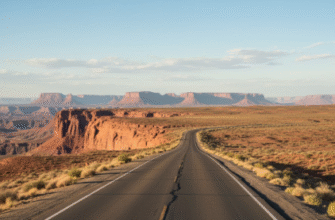
Here’s the thing: driving along what locals vaguely call the Limestone Ridge route between Mexican Hat and the Hogback area isn’t some officially designated scenic byway with interpretive signs every half-mile. It’s more like stumbling through the result of 300 million years of depostion, uplift, and erosive chaos while your GPS quietly panics about losing signal. The Mexican Hat rock formation itself—that improbable mushroom of Halgaito Shale capped by a resistant siltstone layer—sits as a monument to differential erosion, where the soft stuff underneath wears away faster than the harder cap rock. I guess it makes sense that the Navajo Nation, which governs much of this land, has watched generations of geologists and tourists gawk at these features while the rocks themselves continue their imperceptibly slow march toward becoming sand again.
The San Juan River Doesn’t Care About Your Scenic Expectations, Honestly
The San Juan carved its meandering path through these limestone units with the patience of a river that’s been cutting downward for millions of years, exposing cross-sections that make sedimentologists weep with joy. Where the river intersects the Hogback’s tilted strata, you can see the entire sequence on display: Hermosa Group limestones, Rico Formation redbeds, and if you’re lucky enough to hike down to river level (which I’ve done exactly once and my knees still haven’t forgiven me), the Paradox Formation evaporites that hint at even older cycles of seawater evaporation and salt deposition.
The thing nobody tells you is how disorienting it feels to stand on limestone that was once a tropical carbonate platform—think ancient Bahamas—in what’s now high desert scrubland where summer temperatures regularly hit 105°F and the only water for miles is whatever the San Juan hasn’t already carried toward Lake Powell.
Modern geomorphologists have traced the river’s incision rate through these formations, calculating downcutting speeds that vary wildly depending on rock hardness, but generally hover around maybe a few millimeters per year during the Quaternary—which sounds pathetically slow until you multiply it by a million years and realize the river has excavated something like 600 vertical meters of rock in some stretches. The limestone layers, being slightly more soluble than sandstones, develop subtle karst features where groundwater has preferentially dissolved the calcium carbonate along fractures and bedding planes, though you’d definately need a geologist’s eye to spot most of these features while bouncing along dirt roads at twenty miles per hour trying not to puncture a tire on volcanic cobbles left behind by Pleistocene gravel terraces.
I’ve seen road cuts near the Hogback where you can press your hand against fossils of brachiopods and crinoids still embedded in the limestone matrix, organisms that thrived in warm shallow seas while Pangaea was still assembling itself on the other side of the planet. Wait—maybe that’s what gets me about this whole landscape: it’s simultaneously monument and cemetery, built from the compacted remains of billions of creatures that never could have imagined their skeletons would one day form a ridge in a desert, tilted at thirty degrees, slowly crumbling back into dust while a handful of curious primates with cameras try to make sense of it all before the sun sets and the temperature drops forty degrees.