I used to think highways were just, you know, highways.
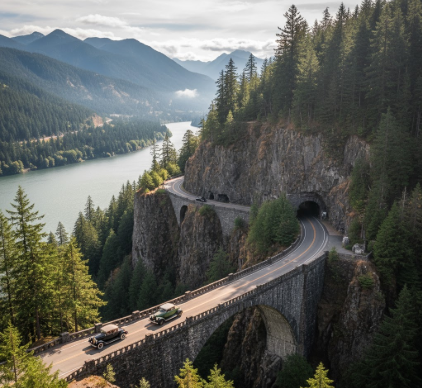
Then I drove the Historic Columbia River Highway in Oregon—this serpentine ribbon of stone and asphalt that clings to basalt cliffs like it was carved by someone who understood that infrastructure could be art—and I realized I’d been wrong about roads my entire life. Built between 1913 and 1922, this engineering marvel wasn’t just about getting from point A to point B; it was about the journey itself, about showcasing the Columbia River Gorge’s waterfalls and vistas in a way that respected the landscape rather than bulldozing through it. Engineer Samuel C. Lancaster, influenced by European alpine roads, designed every curve and grade with the explicit goal of preserving natural beauty. The highway stretches roughly 75 miles from Troutdale to The Dalles, though the most intact scenic sections run about 50 miles, and here’s the thing: it was America’s first planned scenic roadway, a radical idea in an era when most roads were muddy ruts.
When Visionaries Defied the Straight-Line Tyranny of Efficiency
Lancaster’s philosophy was almost subversive for 1913. While other engineers were obsessing over the shortest distance between two points, he was deliberately adding curves—graceful, swooping arcs that followed the contours of cliffs—because he believed travelers should experience beauty, not just efficiency. The highway’s maximum grade never exceeds 5 percent, a remarkable feat given the Gorge’s terrain. Dry-laid stone walls, built without mortar by Italian immigrant masons, still line sections of the route; some of these structures are over a century old and haven’t budged. Tunnels were blasted through basalt headlands, their portals framed with local stone. Bridges—like the iconic Benson Bridge at Multnomah Falls—were designed to complement waterfalls rather than compete with them.
Wait—maybe the most astonishing part is what Lancaster called “poetry in concrete.” He wanted motorists to stop, to actually get out of their newfangled automobiles and stand at purpose-built viewpoints. Crown Point Vista House, completed in 1918, perches 733 feet above the Columbia River like a stone observatory dedicated to wonder.
The Brutal Practicalities of Carving Stone in a Rainforest
Construction was, honestly, a nightmare. Workers used hand tools, black powder, and early steam shovels to cut through volcanic rock in a landscape that receives upwards of 75 inches of rain annually in some sections. Landslides were constant. The basalt cliffs—remnants of massive Miocene lava flows from roughly 15 million years ago, give or take—fractured unpredictably when blasted. Crews had to stabilize slopes while preserving old-growth Douglas firs and western red cedars that were already centuries old. Labor was grueling: immigrant workers, many from Italy and Greece, worked ten-hour days for wages that barely covered room and board. There were injuries, occasional fatalities, and the kind of exhaustion that seeps into your bones when you’re hanging off a cliff face with a pickaxe.
Anyway, they finished it.
How a Highway Became Obsolete and Then Indispensible Again
By the 1950s, the old highway was considered quaint but impractical—too narrow, too winding for modern traffic volumes. Interstate 84 replaced most of it, a straight, efficient scar along the Gorge’s south bank. Sections of the historic route were abandoned, overgrown, reclaimed by moss and ferns. But here’s where the story gets interesting: people missed it. Not the convenience, but the experience. Preservation efforts began in earnest in the 1980s, driven by locals who remembered what it felt like to drive a road that wasn’t just utilitarian. Today, much of the highway is restored and designated as a National Historic Landmark. You can bike it, hike it, drive it slowly with your windows down and the smell of Douglas fir drifting through.
Why We Still Need Roads That Aren’t About Speed
I’ve driven a lot of highways—functional, forgettable stretches of pavement designed by committees who never considered that travel could be transformative. The Columbia River Highway is different because it was built on the radical premise that infrastructure should enhance human experience, not just facilitate movement. Lancaster once wrote that a well-designed road “should not mar but rather accentuate the beauties of nature,” and I guess that philosophy feels almost countercultural now, in an age of GPS-optimized routes and algorithms that shave seconds off commutes. The highway’s legacy isn’t just historical; it’s philosophical, a reminder that engineering can be reverent.
The Unfinished Conversation Between Progress and Preservation
What strikes me most, driving those curves today, is how the highway poses questions we still haven’t answered. Can we build things that last not just physically but emotionally? Can infrastructure inspire rather than just serve? The Historic Columbia River Highway doesn’t resolve these tensions—it embodies them, a century-old argument in stone and asphalt about what we value when we reshape landscapes. Some sections remain closed, damaged by landslides or simply too expensive to maintain. Others thrive, beloved by cyclists and tourists who definately understand they’re experiencing something rare. Turns out, a road designed for Model T drivers doing 25 mph still has something to teach us about how we move through the world, about slowing down enough to actually see where we are, about the stubborn insistence that beauty matters even—especially—in the practical work of getting from here to there.