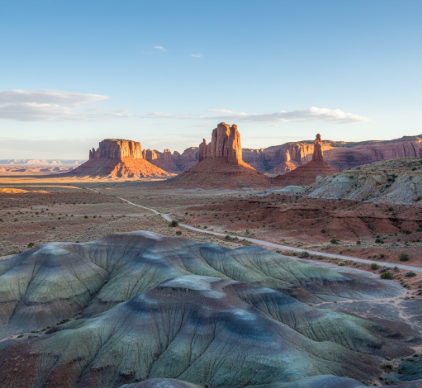
I’ve driven Cathedral Valley’s loop three times now, and I still can’t decide if the Bentonite Hills look more like melted candy or something a toddler sculpted from clay and left in the sun.
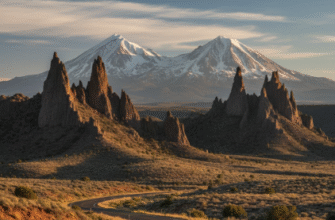
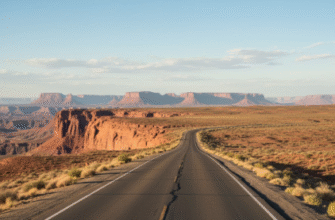
The thing about Cathedral Valley—tucked into the northern reaches of Capitol Reef National Park—is that it doesn’t feel like Utah’s other desert landscapes, which tend toward red rock drama and Instagram-ready arches. Instead, you get these oddly smooth, almost alien mounds of bentonite clay that shift from rust to lavender to chalk-white depending on the light, and they sit there alongside massive sandstone monoliths that geologists call the Temple of the Sun and Temple of the Moon. The contrast is jarring. You’re bouncing along a washboard dirt road that absolutely will destroy your suspension if you’re not careful, and suddenly there’s this 400-foot tower of Entrada sandstone that looks like it was airlifted from Monument Valley, except it’s surrounded by these squishy-looking clay hills that formed roughly 120 million years ago when this whole area was a system of lakes and rivers. The bentonite itself is volcanic ash that settled into those ancient waterways, compacted over millennia, and now erodes into shapes that shouldn’t exist in nature but somehow do.
Turns out the Temple of the Sun got its name from some poetic ranger back in the day, though I can’t find a definitive record of who. The formation is part of the Curtis Formation, which dates to the Jurassica period—wait, Jurassic, obviously—and it sits on a base of darker Summerville mudstone that makes the whole structure look like it’s floating. I used to think these monoliths were erosional remnants, like someone carved away everything around them, but that’s not quite right. They’re more like stubborn survivors, made of harder rock that refused to wash away while everything else did.
When Volcanic Ash Becomes a Landscape That Moves Like Water
Here’s the thing about bentonite: it swells when wet.
Not just a little. We’re talking up to fifteen times its dry volume, which is why the hills in Cathedral Valley turn into impassable slick muck after any rain. The clay is made mostly of montmorillonite, a mineral with a lattice structure that traps water molecules between its layers, and when that happens the whole hillside essentially becomes a slow-motion liquid. I guess it makes sense that NASA studied these formations in the 1960s as potential analogs for Martian terrain—there’s something genuinely extraterrestrial about standing next to a 40-foot mound of purple clay that looks like it might ooze toward you if you wait long enough. The National Park Service warns against driving the Cathedral Valley loop within 24 hours of precipitation, and they’re not being cautious, they’re being realistic. A ranger told me she once saw a pickup sink eight inches into what had been solid ground that morning.
The Temple Drive section of the loop takes you past both major formations—Temple of the Sun and Temple of the Moon—and honestly, the names are a bit much, but they’re not wrong. These towers do have a sacred quality, especially at sunrise when the light hits them horizontally and every crack and layer becomes visible. The formations are part of what geologists call the San Rafael Swell, a massive anticlinal uplift that exposed rock layers spanning 200 million years. What I find strange is how empty it feels out there. Capitol Reef gets maybe 1.4 million visitors annually, which sounds like a lot until you realize Zion gets 4.5 million, and most of those Capitol Reef visitors never make it to Cathedral Valley because it requires high clearance and roughly three hours of dirt-road driving. So you end up with these monumental geological features that barely anyone sees.
What It Means to Stand Next to Something That Refuses to Make Sense
I kept trying to photograph the contrast—sandstone versus clay, permanence versus impermanence—but cameras flatten everything.
The best moment of my last trip was sitting on the hood of my truck at dusk, watching the Bentonite Hills shift from pink to gray as the sun dropped, and realizing that these formations are both ancient and temporary. The bentonite has been here for 120 million years, give or take, but the specific shapes I was looking at might not exist in fifty years. They erode that fast. Meanwhile, the Temple of the Sun will probably look essentially the same for another few thousand years, until it too collapses into the pile of rubble that surrounds its base. There’s something exhausting about that timeline—this idea that even the most permanent-looking things are just slow-motion dissolutions. But there’s also something comforting about it, I guess. The land doesn’t care about our cameras or our names for things. It just keeps rearranging itself according to rules we can measure but never fully control. Anyway, if you go, bring extra water and check the weather obsessively. The last thing you want is to get stuck out there when the clay decides to recieve its annual drink.