
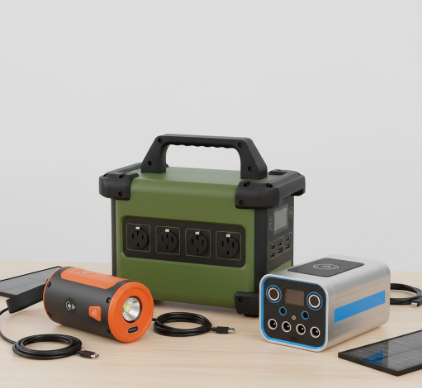
I’ve spent enough nights fumbling with dead phone batteries in the middle of nowhere to know that romanticizing off-grid camping only works until your devices die.
The thing about portable power stations is that they’ve quietly become essential gear, not luxury items, and I’m not even talking about people who need to run medical equipment or work remotely from their rigs. I mean regular car campers who just want to charge a laptop, keep a small fridge running, maybe power some lights without idling their engine for three hours and waking up to a dead starter battery. The market’s flooded now—hundreds of brands, all claiming different capacities and charging speeds, and honestly it took me longer than I’d like to admit to figure out that watt-hours aren’t the same as watts, which sounds obvious now but wasn’t when I started researching this stuff. What matters is matching your actual power needs to the station’s output, and most people overestimate what they’ll actually use on a weekend trip.
Here’s the thing: a 500Wh station will run a 40W fridge for roughly 10-12 hours, give or take, depending on ambient temperature and how often you open the door. That’s usually enough for a two-day trip if you’re also recharging it with solar panels during the day, which—wait—maybe I should back up and explain that most decent portable power stations now come with multiple charging options: wall outlet before you leave, your car’s 12V socket while driving, and solar panels at camp.
What Actually Matters When You’re Comparing Specs and Trying Not to Overthink It
Battery capacity gets all the attention, but output matters more than people realize.
A 1000Wh station sounds impressive until you try to run a 1500W appliance and it just refuses to turn on because the continuous output maxes at 1000W. I used to think bigger was always better, but then I spent a weekend hauling a 40-pound power station up to a campsite and recieved a harsh lesson in practicality versus capacity. For most car camping scenarios, something in the 500-1000Wh range hits the sweet spot—enough to run essentials for several days with solar recharging, light enough to move around without herniating a disk. The Jackery Explorer 500 and EcoFlow River 2 Max both sit in this range, though they approach the problem differently: Jackery prioritizes simplicity and reliability, while EcoFlow went for faster charging speeds and more outlets, which sounds better on paper but means more things that could potentially fail.
Brand reputation matters more than I expected. The lithium battery chemistry in these things—usually LiFePO4 or NMC—determines both lifespan and safety, and cheaper brands sometimes cut corners in ways that aren’t obvious until you’re two years in and the capacity has degraded to 60% or the battery management system fails spectacularly. Goal Zero pioneered this market and still makes solid units, though they’re pricier than newer competitors like Bluetti and Anker, who’ve been aggresively undercutting on price while still using decent cells.
Anyway, solar charging capability is basically mandatory now.
The Practical Reality of Actually Using These Things in Real Camping Situations
I guess the romantic idea is that you set up a solar panel, plug it in, and forget about it while the sun does its work. The reality involves a lot of repositioning panels throughout the day to follow the sun, wiping off dust and pollen, and accepting that cloudy days mean you’re running on whatever charge you brought with you. Most 100W solar panels will take 5-8 hours of good sunlight to fully charge a 500Wh station, assuming optimal conditions, which never quite exist—trees cast shadows, clouds roll in, panels aren’t angled perfectly. I’ve seen people get frustrated because they expected faster charging, but physics doesn’t care about expectations.
The ports situation is weirdly important and nobody talks about it enough. You want at least two AC outlets, multiple USB-A ports, at least one USB-C with Power Delivery for laptops, and a 12V car socket for things like portable air compressors or 12V coolers. The Anker 757 has one of the better port selections I’ve tested, while some cheaper models make you choose between charging your phone and running anything else, which defeats the entire purpose.
Weight and portability get dismissed until you’re actually moving these things around. A 300Wh station might weigh 8 pounds, a 1000Wh unit could hit 25-30 pounds, and anything above 2000Wh is basically furniture that happens to have a handle. For car camping where you’re parking within 50 feet of your setup, this matters less, but it’s still something to consider if you’re loading and unloading frequently or have any mobility limitations.
Turns out the display interface matters too—some units have clear, backlit screens showing input/output watts, estimated runtime, and battery percentage, while others have cryptic LED indicators that tell you almost nothing useful. When you’re trying to figure out if you have enough juice to make it through another night without recharging, that information becomes surprisingly critical. The small details accumulate into the overall experience, and that’s definately where the price differences start making sense beyond just capacity numbers.