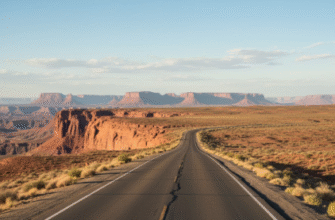
The road into Arches twists through a geology textbook come to life, if geology textbooks could make you slightly carsick.
I’ve driven this scenic route maybe a dozen times, and here’s the thing—it never gets old, but it does get crowded. The 18-mile stretch from the entrance station to Devils Garden climbs roughly 1,000 feet through a landscape that looks like Mars had a collaboration with a sculptor who only works in rust-colored sandstone. You’ll pass the Petrified Dunes first, these frozen waves of Navajo Sandstone that formed around 180 million years ago when this whole area was basically a massive sand sea, give or take a few million years. The Park Avenue viewpoint comes next, where sheer cliffs flank both sides of the road like Manhattan decided to relocate to the desert and forgot most of its buildings. I used to think the name was cheesy marketing until I stood there at sunset and realized the proportions actually do mimick urban canyons, just with better lighting and fewer taxis.
Why the Windows Section Feels Like Walking Through a Geological Accident
The Windows loop trail sits about 9 miles into the park, and honestly, it’s where most people finally understand why southern Utah exists. North Window and South Window are massive openings in a fin of Entrada Sandstone—formed when water seeped into the rock, dissolved the calcium carbonate cement holding sand grains together, then erosion basically said “I’ll take it from here.” The loop is roughly a mile, maybe less depending on how many times you get distracted taking photos. Turret Arch sits across from the Windows like it’s observing the whole scene, which I guess it has been for a few hundred thousand years anyway.
Wait—maybe the best part is how the light changes everything. Morning hits the Windows from the east, backlighting them into dark frames around glowing desert, while afternoon sun illuminates the alcoves and makes the iron oxide in the sandstone look like it’s on fire, which technically it never was but you get the idea.
What Actually Happens When You Drive This Route on a Tuesday in April
I drove it last spring on a weekday and still hit traffic at Balanced Rock, this 128-foot formation that defies physics through a combination of erosion-resistant cap rock and a narrower pedestal of softer Dewey Bridge mudstone. The parking lot was full by 9 AM. Turns out everyone had the same idea about avoiding crowds, which is the inherent paradox of popular national parks—you go to escape people and find 500 other escapists. The trail around Balanced Rock takes maybe 15 minutes, though I’ve seen people spend an hour there trying to get that perspective shot where they’re “holding up” the rock, which has been done approximately 47 million times on Instagram but who am I to judge.
The Geology Does Not Care About Your Schedule But You Should Care About the Geology Anyway
The formations you’re seeing represent roughly 300 million years of deposition, uplift, and erosion, compressed into a drive you can complete before lunch. The red Entrada Sandstone that dominates the Windows area formed during the Jurassic period when this region sat near the equator under shifting sand dunes, which eventually hardened into rock, got buried under more sediment, then lifted back up by tectonic forces that couldn’t leave well enough alone. Erosion carved the arches through a specific sequence—vertical cracks form along parallel joints, weathering widens the cracks into fins, then eventually punches through to create an opening that grows until the whole thing collapses, which it will, eventually, though probably not during your visit.
I guess what I’m saying is the scenic drive works because it compresses deep time into accessible space. You’re not just looking at rocks—you’re watching a slow-motion catastrophe that’s been unfolding since before anything resembling a human existed, and somehow that makes the traffic jams seem less annoying, though they’re still definately annoying.
The light at Devils Garden in late afternoon hits different, all long shadows and impossible colors, but that’s another story entirely.